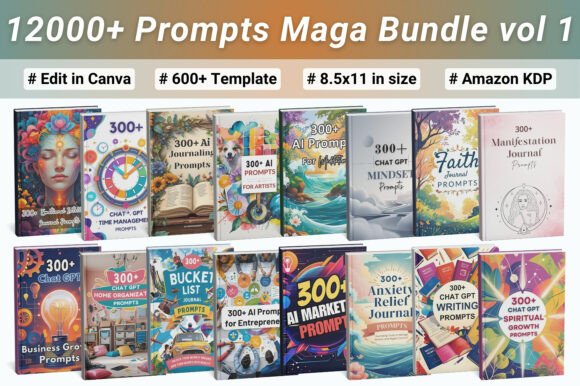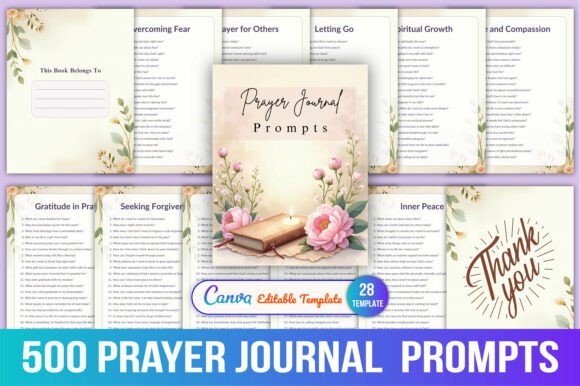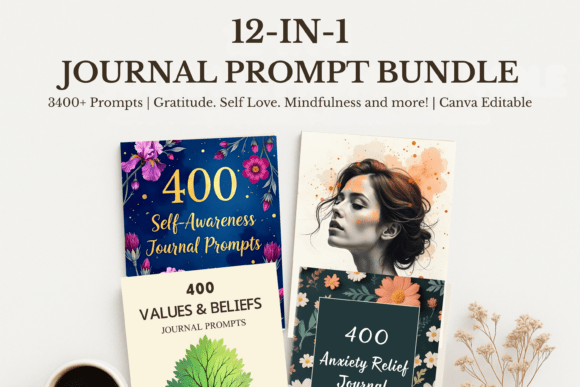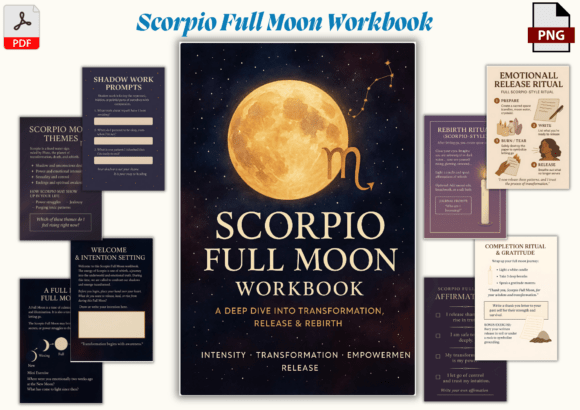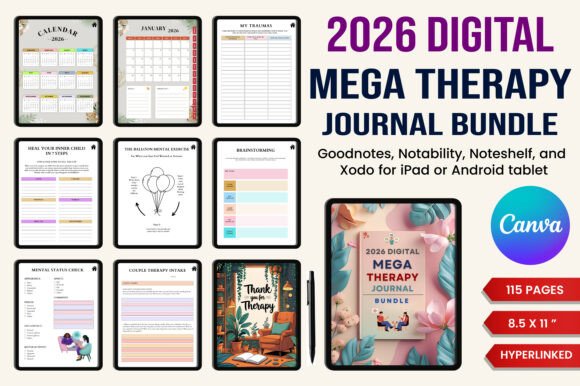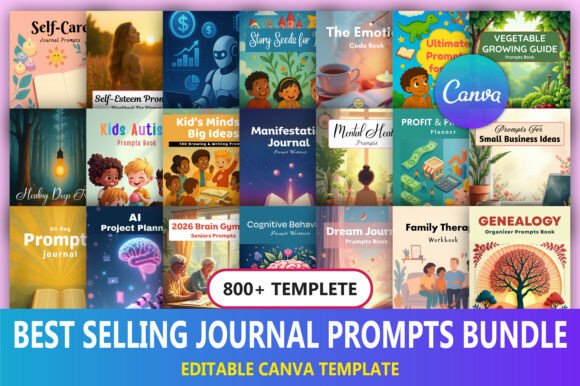
Best Selling Journal Prompts Bundle
Writing isn’t just about output—it’s a lever for thinking, refining, and aligning action with intention. The Best Selling Journal Prompts Bundle is designed not as a static collection of questions, but as an operational toolkit: a set of calibrated inputs that slot into real-world workflows—whether you’re drafting a marketing campaign, supporting a child’s emotional development, launching a small business, or processing grief. Its strength lies in how each component supports a distinct phase of a process: preparation, reflection, iteration, or integration.
Where It Fits in Your Workflow
Unlike generic journaling apps or one-size-fits-all templates, this bundle maps to concrete stages across multiple domains. For example:
- Before a decision: The Cognitive Behavioral Prompts Workbook helps surface automatic thoughts and assumptions—ideal before committing to a hiring choice, pricing strategy, or major personal change.
- During a creative sprint: Story Seeds for Kids and Kid’s Minds Big Ideas aren’t just for educators—they’re structured idea accelerators for writers, content creators, or product designers needing fresh angles under deadline pressure.
- After a project launch: The Profit Prompts Planner guides post-mortem analysis—not just “what sold?” but “what belief shaped that offer?” and “which customer insight went untested?”
- Between sessions with clients or family members: The Family Therapy Workbook and Healing Deep Trauma Prompts Workbook serve as continuity anchors—helping practitioners and caregivers hold space consistently without improvising from scratch each time.
This isn’t journaling as an end in itself. It’s journaling as infrastructure—like version control for your thinking.
Compatibility and Integration
The Best Selling Journal Prompts Bundle works because it’s built for interoperability—not isolation. Each prompt set includes editable Canva links, meaning you can adapt fonts, colors, and layout to match your brand guidelines (e.g., a therapist adding their logo to the Mental Health Prompts PDF before sharing with clients). The high-resolution PDFs print cleanly for in-person workshops; the JPG files embed directly into Notion dashboards, Google Slides presentations, or printed workbooks for group facilitation.
It also complements—but doesn’t replace—other tools:
- Pair AI Project Planner Prompts with ChatGPT or Claude to generate scoped briefs, then use the Smart Money Using ChatGPT prompts to audit assumptions around cost, time, and ROI before execution.
- Use Dream Journal Prompts Book alongside sleep-tracking data (from Apple Watch or Oura Ring) to spot patterns between rest quality and thematic recurrence in dreams—then cross-reference with weekly 60-Day Prompts Journal entries on energy and focus.
- Integrate Vegetable Growing Guide Prompts Book into seasonal planning cycles: answer prompts in late winter to map crop rotation, companion planting goals, and soil prep timelines—then export answers into your gardening app or shared family calendar.
No setup friction. No proprietary software lock-in. Just prompts engineered to plug into what you already use.
Practical Implementation Tips
Start narrow. Pick one prompt set aligned with your current priority—and use it for three consecutive days. Don’t aim for completion. Aim for calibration.
For instance:
- If you’re refining your small business messaging, begin with Prompts For Small Business Ideas. Spend 12 minutes/day answering one prompt—like “What problem did my first paying customer actually solve *for themselves*?” Then review those answers before editing your homepage copy.
- If you’re supporting a neurodivergent child, try Kids Autism Prompts Book during low-stakes moments—after school, before dinner—not during meltdowns. Use the visual cues and sentence starters to co-create predictability, not diagnosis.
- If you’re managing team burnout, assign the Self-Care Journal Prompts as optional pre-meeting reflections. Ask participants to bring one insight—not a full entry—to the next sync. This grounds discussion in lived experience, not abstract advice.
Consistency matters less than fidelity. One well-answered prompt per week beats five rushed ones. And because all files are editable, you can prune, reorder, or combine prompts across workbooks—say, merging The Emotion Code Book’s somatic check-ins with Self-Esteem Prompts Workbook For Women’s boundary-reflection questions to build a custom resilience protocol.
Long-Term Use and Quality Control
This bundle sustains long-term use because it avoids oversimplification. The 2026 Brain Gym for Seniors Prompts, for example, doesn’t treat cognition as decline to be reversed—it frames mental agility as a practice with measurable dimensions: recall speed, associative flexibility, narrative coherence. That precision allows users to track subtle shifts over months, not just “feel better.”
Similarly, the Genealogy Organizer Prompts Book doesn’t ask “Who are your grandparents?” It asks: “Which family story do you hold most confidently—and what evidence supports it? Which story feels unstable, and what source would settle it?” That distinction turns genealogy from nostalgia into historical method.
To maintain quality over time:
- Bookmark your most-used prompts in the PDFs using Adobe Acrobat or Preview—no need to scroll through 100+ pages each session.
- Print only the sections you’ll use in the next 30 days. Keep digital backups synced to cloud storage with clear naming: [Year]_[WorkbookName]_V2_Curated.pdf.
- Every quarter, revisit one completed workbook and scan for recurring themes—not just topics (“money,” “anxiety”), but structural patterns (“I always answer prompts about X with questions, not statements” or “My answers shrink in length after Day 12”). Those patterns reveal where your process needs adjustment—not the prompts.
Real Workflows, Real Outcomes
A freelance copywriter used the Manifestation Journal Prompts Workbook not for wishful thinking, but to reverse-engineer client outcomes: “What does ‘successful deliverable’ look like *to the client’s CFO?’” then “What evidence would make them say ‘this saved us time’?” Those answers reshaped her proposals—and increased her close rate by 27% in four months.
An elementary school teacher layered Ultimate Prompts for Kids into her morning meeting routine—not as a standalone activity, but as a 5-minute bridge between attendance and math instruction. Students chose one prompt (“Draw something that felt heavy yesterday” or “Write one word that describes your brain right now”) and shared only if they wished. Within six weeks, classroom transitions shortened by 40%, and behavior referrals dropped.
A small-scale organic farmer applied the Vegetable Growing Guide Prompts Book to assess risk exposure: “If frost hits two weeks early, which three crops have the highest margin of error—and what’s my Plan B for each?” That exercise uncovered hidden dependencies in his seed order—and saved him $1,800 in replanting costs last season.
These aren’t outliers. They’re examples of the Best Selling Journal Prompts Bundle functioning as intended: not inspiration, but instrumentation—measuring what matters, revealing what’s hidden, and grounding next steps in clarity, not guesswork.
Getting Started Without Overwhelm
You don’t need to use all 12 components at once—or ever. Start with the one that reduces friction in a current bottleneck. If goal-setting feels vague, open the 60-Day Prompts Journal. If team alignment is slipping, test the Family Therapy Workbook’s communication prompts in your next retrospective. If creative blocks stall your blog, pull three Story Seeds for Kids prompts and rewrite them for adult readers.
The value isn’t in owning every file. It’s in having the right prompt, at the right moment—ready, adaptable, and grounded in real use.