Lined Pages Distressed Background: A Practical Resource for Authentic Document Design
Distressed textures carry a quiet authority in visual communication—suggesting authenticity, craftsmanship, and thoughtful imperfection. Among digital design assets, the Lined Pages Distressed Background stands out not as mere decoration, but as a functional bridge between analog warmth and digital precision. Unlike generic grunge overlays or overprocessed vintage filters, this collection delivers purpose-built lined paper textures that retain legibility, structural integrity, and tactile credibility. Designed for real-world use—not just aesthetic flourish—it supports workflows where tone, context, and readability matter equally.
What Makes These Backgrounds Functionally Distinct?
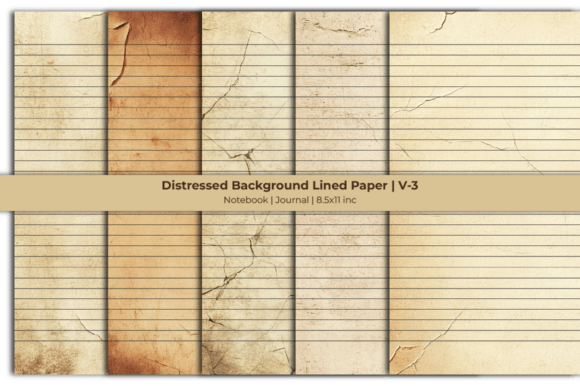
The Volume-3 Distressed Background Lined Paper set is built around intentionality. Each of the five included backgrounds begins with a clean 8.5 × 11 inch lined paper base—standard letter size, universally compatible with print and screen-based tools—and then applies subtle, non-distracting distressing. This isn’t heavy grain, ink bleed, or aggressive tearing. Instead, you’ll find softly faded ruling lines, gentle paper toning (warm ivory to soft gray), faint fiber texture, and occasional micro-wear along edges—details that echo decades of careful use without compromising clarity.
Crucially, the distressing avoids obscuring line spacing or interfering with text placement. That means whether you’re overlaying typed notes, handwritten annotations, or layered design elements, the underlying structure remains legible and usable. This balance separates it from decorative-only assets: these are *working* backgrounds, engineered for integration—not just visual garnish.
Real-World Applications Across Diverse Roles
Professionals and creators don’t adopt distressed paper textures for nostalgia alone. They choose them when the medium must reinforce the message—and that decision unfolds differently across fields.
Educators and Instructional Designers
In learning materials, perceived effort and human presence increase engagement and retention. An educator preparing a printable study guide might use one of the Lined Pages Distressed Background files as a base layer—then add bullet-point summaries, vocabulary tables, or reflection prompts directly on top. The texture signals “hand-curated,” subtly encouraging students to treat the material as personally relevant rather than mass-produced. Similarly, online course designers embed these backgrounds behind discussion prompts in LMS interfaces, grounding asynchronous conversations in a more intimate, notebook-like context.
Researchers and Academic Writers
Qualitative researchers often share field notes, interview transcripts, or coding memos with collaborators. Using a distressed lined background for internal documents adds a layer of contextual honesty—acknowledging that analysis is iterative, messy, and grounded in real observation. It also visually differentiates working drafts from formal submissions, helping teams quickly identify document status at a glance. One anthropology researcher reported using the lightest-toned background in her ethnographic journal PDFs, noting that reviewers consistently described the output as “grounded” and “accessible”—a perception reinforced by the restrained texture.
Hobbyists and Journalers
Digital journaling has surged—not as replacement for pen-and-paper, but as a flexible extension of it. With the included PNG and JPG files, users can import textures into apps like GoodNotes, Notability, or Obsidian with custom templates. The PDF version serves as a ready-to-print physical journal page, while the source file (typically layered PSD or AI) allows for custom line spacing adjustments—ideal for calligraphers needing wider interlinear gaps or bullet journalers experimenting with modular layouts.
Small Business Owners and Marketers
A local bakery launching a seasonal menu doesn’t need sterile corporate templates. Using the Volume-3 Distressed Background Lined Paper as a base for a downloadable PDF menu conveys artisanal care without requiring custom illustration. Likewise, service-based businesses—a freelance editor, a yoga instructor, a home repair specialist—use these backgrounds for client-facing worksheets: intake forms, goal-setting trackers, or progress logs. The texture communicates approachability and personal attention, reinforcing brand voice far more effectively than stock photography ever could.
File Flexibility: Why Format Variety Matters
The inclusion of JPG, PNG, PDF, and source files isn’t redundancy—it’s workflow foresight. Each format serves a distinct practical role:
- JPG: Optimized for web use—lightweight, universally supported, ideal for email newsletters, blog post visuals, or social media graphics where transparency isn’t needed.
- PNG: Preserves transparency, enabling seamless layering over photos, color blocks, or branded headers. Essential for designers building custom Canva templates or Figma UI kits.
- PDF: Print-ready with embedded fonts and fixed dimensions—no scaling surprises, no missing layers. Used directly in Adobe Acrobat for form fields or exported to physical printers without color shift.
- Source file: Grants full editability—adjusting contrast, recoloring lines, modifying distress intensity, or isolating texture layers for hybrid use. For advanced users, this transforms a static asset into a customizable system.
This multi-format approach reflects how professionals actually work: rarely confined to a single tool or output channel. A graphic designer may start in Photoshop (using the PSD source), export a PNG for a client presentation, then drop the JPG into a WordPress landing page—all from the same foundational asset.
Implementation Considerations: Avoiding Common Pitfalls
Even well-designed distressed backgrounds can undermine communication if misapplied. Three considerations consistently emerge from user feedback:
Contrast and Readability First
While the Lined Pages Distressed Background maintains high contrast between lines and paper tone,叠加 additional semi-transparent layers—or setting text in light gray on a warm-toned background—can erode legibility. Always test final outputs at actual viewing size: zoom to 100% in your PDF viewer, open the PNG on a mobile device, or print a sample page. If line weight appears inconsistent or text seems to “vibrate” against the background, reduce opacity or switch to a higher-contrast variant.
Intentional Scale and Repetition
These are single-page assets—not seamless tiles. Attempting to tile them across large banners or presentations creates visible seams and disrupts the authentic “single sheet” impression. Instead, use them as intentional frames: full-page backgrounds for reports, centered overlays for certificates, or cropped sections for testimonial cards. When scaling is necessary, constrain proportions and avoid stretching—distortion breaks the illusion of physical paper.
Contextual Alignment
A distressed lined background strengthens messaging only when it matches audience expectations. It fits naturally in creative portfolios, educational handouts, or artisan branding—but feels incongruous in regulatory compliance documents, financial disclosures, or technical specifications. Ask: does this texture support trust, warmth, or personality? Or does it inadvertently signal informality where rigor is expected? Matching texture to purpose—not just preference—is where functional design begins.
Why “Instant Download” Is a Workflow Necessity—Not Just Convenience
The note “INSTANT DOWNLOAD. No physical item will be sent” reflects more than transactional efficiency—it speaks to how modern knowledge work operates. Educators preparing lesson plans the night before class, researchers responding to peer review deadlines, or small business owners updating seasonal offers can’t wait for shipping. They need reliable, predictable access: no login delays, no file corruption, no regional restrictions. The ZIP delivery ensures version control (all formats bundled under one consistent naming convention), eliminates cloud dependency, and allows offline use—critical for those working in low-bandwidth environments or prioritizing data privacy.
Moreover, instant access enables iterative refinement. A writer might test three different backgrounds against the same paragraph of body text, comparing how each affects reading speed and comprehension. A designer might build mockups across devices in under ten minutes—something impossible with physical swatch books or delayed cloud links.
Looking Beyond Aesthetics: The Role of Texture in Digital Trust
In an era of algorithmic feeds and synthetic media, tangible cues gain renewed significance. A thoughtfully distressed lined background doesn’t simulate age—it signals human authorship. It says: *this was made by someone who considered how it would be used, not just how it looks.* That subtext resonates across audiences: students sense pedagogical care, clients infer attentiveness, collaborators perceive shared standards of craft.
This isn’t about rejecting digital efficiency. It’s about enriching it—using texture as a quiet carrier of intent. The Lined Pages Distressed Background collection succeeds because it refuses to choose between beauty and utility. Its lines guide the eye; its distressing grounds the experience; its formats honor diverse tools and constraints. Whether printed on recycled stock or viewed on a tablet screen, it functions first—and evokes second.
Ultimately, the most effective design assets disappear into the work they support. You don’t admire the paper—you focus on the idea, the instruction, the story. And when the background does its job well, that’s exactly what happens.