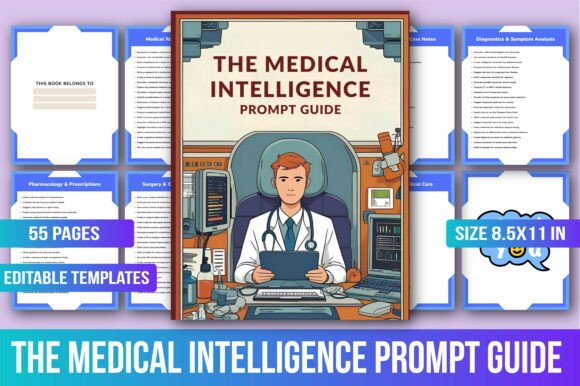
The Medical Intelligence Prompt Guide: A Practical Framework for Human-Centered AI in Healthcare
Artificial intelligence is no longer a speculative addition to medicine—it’s an operational reality. Yet its adoption remains uneven, often limited by fragmented tools, steep learning curves, or misalignment with clinical reasoning. What’s missing isn’t more algorithms, but better interfaces between human expertise and machine capability. That’s where The Medical Intelligence Prompt Guide emerges—not as software, but as a living framework: a curated, discipline-grounded collection of AI prompts designed to amplify, not replace, clinical judgment.
Why Prompts Matter More Than Platforms in Clinical Practice
In healthcare, accuracy without context is dangerous. A model may generate statistically plausible differential diagnoses—but without grounding in patient age, social determinants, local epidemiology, or institutional protocols, those outputs risk being academically sound yet clinically inert. Prompts act as precision filters: they encode domain-specific logic, ethical guardrails, and workflow constraints before a single token is processed.
Consider a geriatrician reviewing a new case of unexplained fatigue. A generic prompt like “list causes of fatigue” yields 40+ items—many irrelevant to frailty, polypharmacy, or late-life depression. In contrast, a prompt from The Medical Intelligence Prompt Guide might read:
- “Generate a prioritized differential diagnosis for fatigue in a 82-year-old female with stage 3 CKD, on lisinopril, metoprolol, and gabapentin—emphasizing medication-induced causes, subclinical infection, and functional decline red flags. Exclude rare endocrine disorders unless supported by local lab availability.”
This isn’t just specificity—it’s clinical stewardship encoded in language. Each prompt embeds implicit knowledge: pharmacokinetic awareness in aging, resource-aware diagnostics, and harm-reduction priorities. That’s the core value proposition: structured intelligence over raw output.
Workflow Integration Across Six High-Impact Domains
Rather than treating AI as a standalone tool, The Medical Intelligence Prompt Guide maps directly onto daily clinical workflows—each section built around real-world friction points.
Diagnosing with Confidence, Not Guesswork
Symptom analysis here moves beyond checklists. Prompts guide clinicians through layered reasoning: first identifying pattern recognition anchors (e.g., “Is this pain pleuritic, pericardial, or musculoskeletal?”), then triggering red-flag cascades (“If fever + neck stiffness present, activate meningitis protocol checklist”). One cardiology prompt helps interpret borderline ECG findings by prompting comparison against age- and sex-adjusted normative baselines—reducing false positives in young women with early repolarization.
Documenting Without Drudgery
Notes consume nearly 50% of physicians’ non-clinical time. The guide’s SOAP note templates don’t auto-fill—they scaffold thinking. A pediatric prompt for acute otitis media asks: “List observed tympanic membrane findings, differentiate bulging vs. injection, specify laterality and effusion type, then draft parent-facing discharge instructions using ≤3rd-grade literacy.” This ensures documentation serves both legal rigor and health literacy—two goals rarely optimized simultaneously.
Prescribing With Pharmacovigilance Built-In
A prescription prompt doesn’t just suggest dosing—it forces consideration of absorption variables: “For a 68-year-old with gastroparesis and recent Roux-en-Y, recommend alternatives to oral metformin with rationale, including renal clearance adjustments and monitoring parameters.” Interactions aren’t flagged passively; prompts require explicit reconciliation: “Cross-check this new SSRI against current anticoagulant, antiplatelet, and antiepileptic regimens—highlight serotonin syndrome risk AND bleeding synergy.”
Mental Health Support That Scales Responsibly
Therapy prompts avoid prescriptive scripts. Instead, they support clinician intentionality: a CBT prompt for adolescent anxiety might ask, “Suggest three behavioral experiments calibrated to school re-entry challenges—each with measurable success criteria and contingency plans for avoidance escalation.” Another guides motivational interviewing for smoking cessation by prompting reflection on identity shifts (“How would ‘a non-smoker’ handle stress at work?”) rather than willpower appeals.
Nutrition Guidance Anchored in Real Life
Generic meal plans fail because they ignore food access, cooking ability, and cultural meaning. A nutrition prompt for type 2 diabetes in a low-income urban setting reads: “Design a 3-day rotating grocery list using only Walmart or Aldi staples under $45/week, requiring ≤15 min prep, accommodating halal dietary laws, and substituting canned beans for fresh legumes where refrigeration is unreliable.” This reflects public health pragmatism—not theoretical idealism.
Emergency Response Where Seconds and Clarity Converge
In trauma or code situations, cognitive load skyrockets. Pre-op prompts include embedded mnemonics: “Run the M-A-I-N-T-A-I-N checklist: Medications reviewed? Allergies confirmed? IV access secured? NPO status verified? Temperature monitored? Airway plan documented? Imaging completed? Next steps assigned?” Post-op prompts focus on transition safety: “Identify the top 3 discharge risks for this CABG patient with COPD and mild dementia—then draft nurse-to-caregiver handoff bullets emphasizing inhaler technique over medication names.”
Who Benefits—and How Their Needs Shape the Guide
The utility of The Medical Intelligence Prompt Guide diverges meaningfully across user groups—not because it’s diluted, but because its modular design allows selective depth.
- Residents and students use diagnostic flowchart prompts to rehearse clinical reasoning aloud, turning passive reading into active schema-building.
- Primary care teams deploy public health prompts to co-create neighborhood-specific hypertension campaigns—e.g., “Draft bilingual SMS reminders for BP check-ups targeting Spanish-speaking seniors in Miami-Dade, referencing local free clinic hours and bus routes.”
- Researchers leverage hypothesis-generation prompts that force methodological rigor: “Propose a mixed-methods study on telehealth adherence in rural oncology patients—specify primary outcome (not just ‘engagement’ but ‘timely symptom reporting leading to intervention’), control for broadband reliability, and name two qualitative probes to uncover unreported tech barriers.”
- Health system administrators apply policy prompts to equity audits: “Map current diabetes screening rates by census tract income quartile—then draft a targeted outreach strategy addressing transportation gaps, not just awareness deficits.”
Implementation Considerations: Beyond the Prompt
Adopting The Medical Intelligence Prompt Guide isn’t about copying and pasting. It requires calibration:
Contextual fidelity matters more than technical perfection. A dermatology prompt for melanoma triage works only if integrated with your EHR’s image upload capability and local dermatopathology turnaround times. A prompt asking for “dermoscopic feature analysis” is useless without access to validated dermoscopy images.
Iteration is non-negotiable. One academic medical center tested 12 sepsis prompts across three ED shifts. Only four achieved >85% clinician acceptance—those explicitly included triage-level language (“If lactate >4, initiate bundle BEFORE blood cultures”) and excluded jargon like “vasopressor-resistance.” The rest were revised based on nurse feedback about cognitive load during handoffs.
Ethical boundaries are baked in—not bolted on. Every prompt includes implicit consent scaffolding. A mental health journaling prompt for teens states: “Do not generate content suggesting self-diagnosis. Frame reflections as observations—not conclusions. If themes of self-harm emerge, prompt user to contact crisis line and share location-based resources.”
Looking Ahead: From Prompt Library to Practice Infrastructure
The most promising evolution of The Medical Intelligence Prompt Guide lies not in expanding volume, but in deepening interoperability. Early pilots integrate prompts directly into clinical documentation systems—so a cardiologist dictating “patient reports crushing chest pain” auto-triggers the ACS differential prompt within their ambient scribe interface. Others link pharmacology prompts to real-time formulary databases, flagging prior authorization requirements before the prescription is finalized.
What remains constant is the north star: AI as a force multiplier for human insight, not a substitute for it. The guide doesn’t claim to diagnose, treat, or decide—it creates structured pathways for clinicians to apply their irreplaceable skills: contextual interpretation, ethical weighting, and compassionate translation. In an era of escalating complexity, that distinction isn’t semantic. It’s the difference between automation that erodes trust—and intelligence that restores capacity.
As one community health director observed after piloting the public health section: “We stopped asking ‘What does the AI say?’ and started asking ‘What do we need the AI to help us clarify?’ That shift—from passive recipient to intentional architect—is where real medical intelligence begins.”