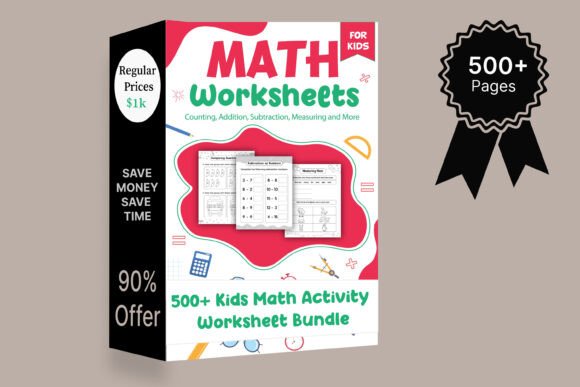
Math Activity Worksheet Bundle for Kids
If you’ve ever watched a child light up while matching shapes, count out toy coins, or proudly write their first number sequence—you know how powerful hands-on math practice can be. The Math Activity Worksheet Bundle for Kids isn’t just another stack of printable pages. It’s a 500-page, editable toolkit built for real moments: the quiet focus of a homeschooled kindergartener tracing clock faces, the collaborative buzz in a preschool circle time as kids compare lengths of paper strips, or the creative spark when a content creator adapts a “Count and Color” page into an animated learning video.
This bundle meets learners where they are—whether that’s recognizing numerals, grasping place value, estimating mass with balance scales, or adding small amounts of money using realistic price tags. And because every worksheet is delivered as an editable AI PDF (compatible with Adobe Illustrator), it doesn’t lock you into static content. You can adjust fonts for dyslexic readers, swap images to reflect diverse classrooms, translate instructions for bilingual families, or resize grids for tactile learners using raised-line overlays.
Where This Bundle Fits Into Real Days
Think beyond “just worksheets.” Picture these everyday scenes:
- A homeschool parent preparing for a busy week uses the “Missing Number” and “Number Pattern” pages to create a rotating math center—pairing them with magnetic numbers and dry-erase markers so her 6-year-old practices independently while she supports her younger child.
- An early childhood educator in a Title I preschool pulls the “Compare Length of Objects” and “Measuring Mass” sheets to anchor a unit on measurement—printing them on cardstock, laminating, and pairing with classroom tools like linking cubes and pan balances for kinesthetic exploration.
- A curriculum designer building a summer learning program for low-income communities adapts the “Add Money Value” and “Adding Price” activities into community-based scenarios—like calculating costs at a pretend farmers’ market using local produce names and culturally relevant items.
- A special education paraprofessional modifies the “Circle the Correct Number” and “Color the Correct Number” pages by increasing font size, simplifying visual clutter, and adding tactile elements—then prints them on textured paper for a student who benefits from multi-sensory input.
What makes this possible isn’t just volume—it’s intentional design. Pages aren’t grouped only by skill (e.g., “addition”), but by cognitive demand and access point. A child struggling with one-to-one correspondence might start with “Count the Blocks,” then move to “Draw The Blocks” to reinforce quantity-symbol relationships, and later tackle “Balance The Numbers” to explore equivalence—all within the same cohesive visual language.
Who Benefits—and How Their Needs Shape Use
The Math Activity Worksheet Bundle for Kids serves distinct audiences—not as a one-size-fits-all product, but as a flexible foundation:
- Homeschooling parents appreciate having editable files because they often juggle multiple grade levels and learning styles. Being able to remove time-sensitive clipart (e.g., holiday themes) or add personalized prompts (“How many apples does Sam have?”) keeps practice meaningful—not generic.
- Classroom teachers use the “Data Collection” and “Estimate the Numbers” pages during morning meetings or transition times—turning quick 5-minute routines into authentic math talk. The editable format also lets them align vocabulary with district scope-and-sequence documents (e.g., swapping “digit value” for “tens and ones” where appropriate).
- Educational content creators leverage the Illustrator-ready files to build custom digital products—think interactive Boom Cards, Canva-based mini-workbooks, or YouTube companion printables. Since assets are layered and labeled, swapping backgrounds or isolating icons takes minutes—not hours.
- Therapists and intervention specialists rely on high-contrast, uncluttered layouts found across the bundle—especially in “Matching Shapes,” “Comparing Quantities,” and “Missing Even/Odd Number” sections—to support visual processing goals without needing to redesign from scratch.
Practical Considerations Before You Dive In
While the Math Activity Worksheet Bundle for Kids offers remarkable flexibility, a few grounded considerations help maximize its impact:
- Editing requires basic Illustrator familiarity. You don’t need to be a designer—but knowing how to select layers, edit text boxes, and export PDFs ensures smooth customization. If you’re new to Illustrator, plan 30–45 minutes to explore the file structure before adapting your first page.
- Not all pages suit every learner out-of-the-box. For example, “Rounding off and Estimation” assumes foundational number sense. Use the “Concept of Addition” and “Count the Shapes” pages first to scaffold understanding—then layer in estimation as confidence grows.
- Physical printing matters. Many activities—like “Measuring Mass” or “Balance The Numbers”—are most effective when paired with real manipulatives. Keep linking cubes, balance scales, play coins, and rulers nearby. The worksheets guide the thinking; the objects make it stick.
- Context beats completion. Don’t aim to “get through” all 500 pages. Instead, pick 3–4 high-leverage activities per week—ones that connect to current interests (e.g., “Add Money Value” during a pretend bakery theme) or observed gaps (e.g., “Missing Number” if skip-counting is shaky).
Strengths That Stand Out—And One Honest Note
Its biggest strength? Adaptability without compromise. Unlike fixed PDFs that force workarounds—or resource-light bundles that leave you hunting for supplemental materials—this set gives educators and caregivers agency. You decide whether a “Clock faces” worksheet becomes a cut-and-paste craft, a whiteboard warm-up, or a screen-shared activity during virtual learning. The editable files preserve clean lines, consistent spacing, and thoughtful typography—so changes enhance, rather than undermine, clarity.
One practical limitation: it’s designed for early math, meaning coverage peaks around late Grade 2 concepts (e.g., two-digit addition with regrouping, basic fractions, introductory geometry). It won’t replace upper-elementary problem-solving tasks or algebraic reasoning tools—and it’s not meant to. Its power lies in building the intuitive, concrete foundations those later skills depend on.
So if you’re looking for something that grows with your child, shifts with your teaching role, and stays useful whether you’re guiding a lesson in person, online, or on the go—the Math Activity Worksheet Bundle for Kids isn’t just a download. It’s a quietly reliable partner in making math feel alive, accessible, and deeply human.