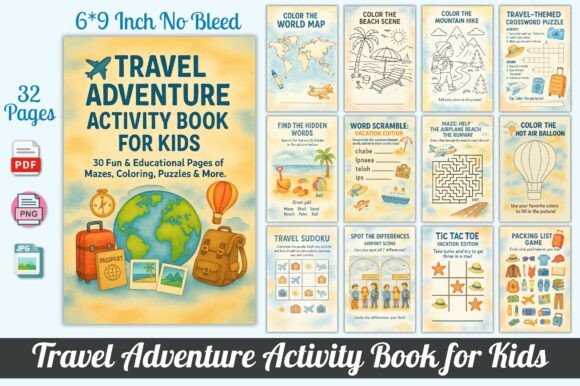
Travel Adventure Activity Book for Kids: A Practical Learning Companion for Real-World Journeys
When a family packs suitcases, books the flight, or maps out a road trip, one question lingers in the background: How do we keep young minds actively engaged—not just occupied—while moving through space and time? The answer isn’t always another screen. Increasingly, educators, parents, and travel-savvy caregivers are turning to intentionally designed, printable resources like the Travel Adventure Activity Book for Kids. More than a collection of pastimes, it functions as a portable learning ecosystem—one that aligns with how children aged 5–10 naturally explore, question, create, and make sense of the world around them.
Why Travel-Themed Learning Resonates Beyond the Vacation Itself
Travel is inherently interdisciplinary. A single airport departure gate introduces concepts in geography (time zones, continents), logistics (schedules, sequencing), language (signage, greetings), economics (currency exchange, budgeting), and cultural awareness (customs, traditions). Yet most traditional curricula introduce these topics abstractly—through textbooks or isolated worksheets. The Travel Adventure Activity Book for Kids bridges that gap by embedding academic concepts into authentic, emotionally resonant contexts.
Consider a child completing the “Design Your Passport” activity. They’re not just coloring a cover—they’re learning about national symbols, practicing fine motor control, reinforcing letter formation while writing their name and birthplace, and beginning to grasp the idea of identity documentation. Similarly, a map-based scavenger hunt across a simplified world map doesn’t just teach location; it builds spatial reasoning, reinforces cardinal directions, and invites comparative thinking (“Why is Japan east of India?”).
Structure That Serves Developmental Needs—Not Just Entertainment
The effectiveness of the Travel Adventure Activity Book for Kids lies in its layered scaffolding. Each section responds to documented cognitive and psychomotor milestones:
- Early elementary (ages 5–7): Mazes reinforce hand-eye coordination and sequential logic; picture-based packing lists support categorization and memory recall; “Draw Your Dream Destination” nurtures imaginative storytelling and pre-writing skills.
- Later elementary (ages 8–10): Word searches use travel-related vocabulary (e.g., “itinerary,” “compass,” “archipelago”) to expand domain-specific lexicons; “Create a Postcard” prompts integrate descriptive writing, audience awareness, and perspective-taking; “Spot the Difference” challenges build visual discrimination and attention to detail—skills directly transferable to scientific observation or historical document analysis.
This progression isn’t accidental. It mirrors research on executive function development: younger children benefit from concrete, visually guided tasks, while older learners thrive when given open-ended prompts requiring planning, self-monitoring, and synthesis.
Real-World Applications Across Diverse Settings
While designed with transit in mind—car rides, train platforms, airport lounges—the Travel Adventure Activity Book for Kids demonstrates remarkable adaptability across environments and roles:
Families Building Shared Meaning
A cross-country drive becomes collaborative inquiry when kids track mileage on a route map, tally landmarks spotted, or journal daily reflections using the “My Travel Journal” pages. These aren’t busywork exercises—they’re low-stakes opportunities to practice observation, narrative sequencing, and emotional articulation. One parent reported using the “Packing List Challenge” to co-create a real suitcase checklist, transforming a logistical task into a lesson in prioritization and consequence (“What happens if we forget raincoats?”).
Homeschoolers Anchoring Units in Experience
Educators integrating geography or social studies often struggle to move beyond static atlases. With the Travel Adventure Activity Book for Kids, a unit on Southeast Asia might begin with the “Design Your Passport” page for Thailand, followed by a word search featuring terms like “Bangkok,” “Chao Phraya,” and “wai.” Later, students sketch traditional clothing or draft a postcard from Chiang Mai—connecting language, art, history, and personal voice.
Classroom Teachers Extending Thematic Learning
In schools, the printable format allows teachers to assign targeted pages aligned with standards. A third-grade teacher used the “Map Game: Find the Capital” page during a unit on U.S. states, then adapted it for a follow-up on European capitals. Because the file set includes editable elements (like blank passport stamps and customizable destination cards), educators can localize content—replacing generic “Paris” prompts with “New Orleans” for a regional study—or layer in differentiated supports (e.g., adding phonetic hints to vocabulary words).
Design Choices That Support Inclusive, Sustainable Use
Several intentional features elevate the Travel Adventure Activity Book for Kids beyond typical printables:
- 6 × 9 inch dimensions: Fits standard binders and backpack pockets without folding or trimming—critical for maintaining usability during movement. Unlike oversized workbooks, it avoids bulk while preserving ample writing space.
- Black-and-white interior: Ensures accessibility for home printers and reduces ink costs. High-contrast line art supports children with visual processing differences, and grayscale design encourages creative interpretation (e.g., “Color the airplane’s route in your favorite color to show where you’d fly first”).
- No required digital tools: All activities function offline. This matters not only for screen-free advocacy but also for equity—families without reliable Wi-Fi or device access retain full functionality. A librarian in rural Maine noted that printed copies circulated successfully through summer reading programs where tablet lending was limited.
Integration Into Broader Learning Ecosystems
The Travel Adventure Activity Book for Kids gains depth when paired with complementary practices—not as a standalone product, but as a node in a larger web of engagement:
- Pre-trip activation: Assign the “Dream Destination” prompt weeks before departure. Children research real facts (climate, language, animals) to inform their drawings—blending imagination with information literacy.
- During-trip documentation: Use “Travel Journal” pages to record sensory details (“What did the market smell like?”) or “Scavenger Hunt” checklists to notice architecture, signage, or transportation modes.
- Post-trip reflection: Revisit completed pages to identify patterns (“Which countries had blue on their flags?”) or compare predictions with reality (“Did your imagined beach match what you saw?”). This metacognitive layer transforms experience into lasting understanding.
This cyclical approach mirrors best practices in experiential education—where preparation, immersion, and integration form a cohesive learning arc. The activity book serves as both scaffold and artifact across all three phases.
Observations From Field Use
Teachers in diverse settings have observed consistent patterns in student response:
- Increased ownership: Children who typically resist writing tasks eagerly complete “Postcard” pages—especially when they know it will be mailed or displayed.
- Natural differentiation: A child struggling with spelling may draw elaborate suitcase contents while a peer writes multi-sentence descriptions of their “imaginary land.” Both demonstrate conceptual understanding through preferred modalities.
- Unexpected cross-curricular sparks: One fifth-grade class extended the “Design Your Passport” activity into a civics discussion about citizenship requirements, visa processes, and global mobility—prompted entirely by student questions arising from the worksheet.
Practical Considerations for Users
Success with the Travel Adventure Activity Book for Kids depends less on perfect execution and more on flexible implementation:
- Print strategically: Not every page needs printing at once. Start with 3–5 high-interest activities (e.g., maze + scavenger hunt + postcard) to avoid overwhelm. Add new pages based on observed interests or upcoming stops.
- Supplement, don’t replace: Pair mazes with physical manipulatives (e.g., tracing routes with toy cars); use “Draw Your Suitcase” as a springboard for sorting real items by category (clothing, tech, toiletries).
- Model engagement: Adults completing their own “Travel Journal” entry—or attempting the same maze—normalizes effort, celebrates curiosity, and models lifelong learning.
Ultimately, the Travel Adventure Activity Book for Kids reflects a deeper truth: learning thrives not in isolation, but in context—in motion, in anticipation, in shared discovery. It doesn’t ask children to pause their journey to learn. Instead, it invites them to learn through the journey—turning miles into meaning, minutes into mastery, and moments into memories anchored in understanding.