Bible Study Journal Canva Template: A Practical Tool for Intentional Scripture Engagement
For adults balancing faith development with professional responsibilities—whether managing a small business, teaching Sunday school, launching a faith-based blog, or simply carving out quiet time before a demanding workday—a structured yet flexible approach to Bible study matters. The Bible Study Journal Canva Template meets that need not as a rigid curriculum, but as a customizable organizational scaffold. It’s designed for people who value clarity over complexity and consistency over novelty—those who want to track progress, reflect meaningfully, and retain insights without reinventing their workflow.
What This Template Actually Delivers
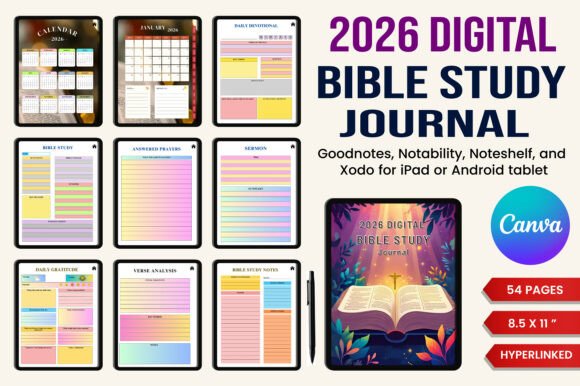
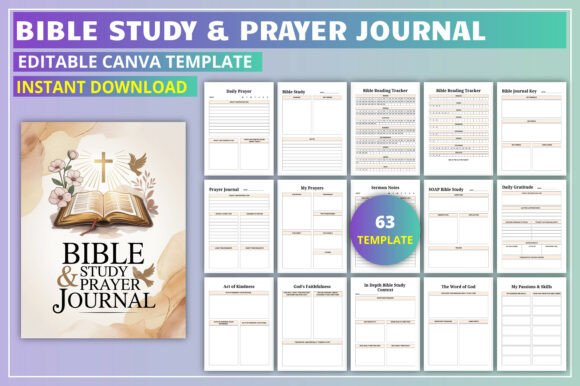
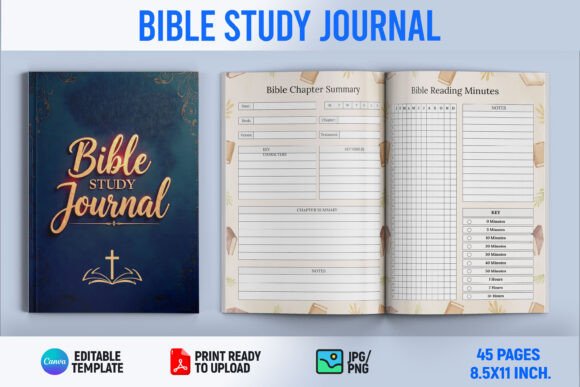
At its core, the Bible Study Journal Canva Template is a digital journal framework built for Canva, with a companion printable PDF. Its 8.5 x 11 inch layout aligns with standard home or office printers, and every section is editable—text, colors, fonts, spacing—without requiring design expertise. Unlike static PDF journals or generic planners, this template assumes users will adapt it: swapping “Bible Study Acts” for personal reflection prompts, repurposing “Sermon Interpretation” pages for small group discussion notes, or using “Bible Verse Map” to trace thematic connections across books.
The included sections reflect practical rhythms of spiritual discipline—not just reading, but processing. “Bible Chapter Summary” supports comprehension after a passage; “Scripture Study” offers space for cross-references and observations; “Prayer Planner” separates intercession from gratitude and petition; “Memory Verses” includes dedicated lines for repetition and application—not just transcription. Even functional elements like “To Do list” and “Checklist” are contextualized within spiritual goals (“Review Galatians 5 this week,” “Prepare discussion questions for Romans 8”), reinforcing intentionality.
Usability in Real-World Contexts
In practice, the Bible Study Journal Canva Template performs well for three distinct use cases: individual consistency, collaborative learning, and teaching preparation.
- Individual use: Professionals with fragmented schedules benefit from “Bible Reading Minutes” and “Bible Reading Tracker”—quantifiable metrics that support habit formation without guilt. “Daily Devotional” and “Grateful For” fit naturally into morning routines, while “Monthly Goals” and “Yearly Goals” link spiritual growth to broader life planning.
- Small groups or accountability partnerships: “Bible Study soap” (likely intended as “SOAP”—Scripture, Observation, Application, Prayer) and “Bible Study reap” (possibly “REAP”—Read, Reflect, Emphasize, Apply) provide shared frameworks. These aren’t proprietary methods, but widely recognized models—making them accessible for newcomers and adaptable for seasoned participants.
- Educators and ministry leaders: “Sermon Notes” and “Sermon Interpretation” offer dual-purpose structure: one for personal listening, another for preparing lessons. “Chapters by Month” helps plan year-long reading plans aligned with liturgical calendars or church themes—useful for pastors, youth leaders, or homeschooling parents.
Notably, the template avoids overloading pages. “Notes” and “Bible Study Notes” appear multiple times—not as redundancy, but as intentional repetition across contexts (e.g., margin notes during reading vs. synthesis after reflection). That design choice reflects an understanding of how learning compounds: initial exposure, then analysis, then application.
Strengths Beyond Aesthetics
While the template is described as “beautifully designed,” its strength lies less in visual flair and more in structural coherence. Each component connects logically to others: “Verses Read” feeds into “Memory Verses”; “Prayer List” informs “Prayers” and “Prayer Needs”; “Daily Gratitude” scaffolds toward “Weekly Gratitude.” This internal logic reduces cognitive load—users spend less time deciding *where* to record something and more time engaging with it.
Reliability comes from format stability. Because it’s built in Canva, users avoid version conflicts common with Google Docs or Notion templates that rely on third-party integrations. Updates to the original file don’t overwrite personal edits—unlike cloud-based auto-sync tools where accidental deletions can cascade. And the printable PDF option ensures continuity: if internet access drops before a retreat or mission trip, the physical journal remains fully functional.
Who Benefits Most—and Who Might Look Elsewhere
The Bible Study Journal Canva Template suits adults who already engage with Scripture regularly but seek better systems—not those starting from zero. Beginners may find the volume of sections overwhelming without guidance on prioritization. Similarly, users committed to analog-only workflows (no Canva access) or those needing advanced features like searchable databases, audio integration, or scripture hyperlinking will find its capabilities bounded by Canva’s native tools.
It’s especially effective for creators and educators who repurpose content. Bloggers documenting their study journey can export clean, branded pages for social posts. Teachers can duplicate “Bible Definitions” pages for handouts, adjusting font size for readability in large classrooms. Freelance designers might use the template as a client-ready base—customizing colors and logos for faith-based coaching packages.
One realistic limitation: while fully editable, Canva’s free tier restricts certain font uploads and background image options. Users wanting extensive branding control may need Canva Pro for full flexibility—though the default typography and layout remain professional and legible without upgrades.
Long-Term Value and Integration
Unlike consumable devotionals or dated planners, the Bible Study Journal Canva Template gains utility over time. As users iterate—reordering sections, deleting unused pages like “Bible Study soap” in favor of custom prompts, or combining “Goal Planner” with “Prayer Needs”—it becomes a personalized artifact of spiritual growth. Educators report reusing the same template across academic years, updating “Sermon Notes” annually while retaining “Bible Verse Map” as a longitudinal reference.
Its effectiveness depends less on perfection and more on regular, low-friction use. A marketing manager might open Canva for five minutes each morning to update “Prayer List” and “Verses Read,” then print weekly pages for offline review during commute time. A small business owner could assign “Monthly Goals” during quarterly planning sessions, aligning spiritual objectives (“Deepen understanding of stewardship”) with operational ones (“Refine pricing strategy”).
Ultimately, the Bible Study Journal Canva Template doesn’t promise transformation—it enables it. It removes friction between intention and action, giving structure to reflection without prescribing theology. For adults navigating complex lives while seeking grounded faith practices, that balance isn’t just convenient. It’s sustainable.