Master Monoline Lettering with This Affirmation-Based Practice Workbook
Whether you're a complete beginner or an experienced handlettering enthusiast, monoline lettering offers a refreshingly accessible entry point into the world of expressive typography. Unlike brush or pointed pen styles that rely on pressure-sensitive strokes to create thick and thin lines, monoline lettering uses consistent line weight throughout—making it ideal for everyday tools like ballpoint pens, gel pens, fine liners, or even pencils. That’s why the Monoline Lettering Practice Worksheet—a 20-page Affirmation Lettering Practice Workbook—is gaining popularity among educators, therapists, students, remote workers, and mindful creatives alike.
What Is Monoline Lettering—and Why Does It Matter?
At its core, monoline lettering is the art of crafting beautiful, intentional letters using uniform stroke thickness. It removes the technical barrier of mastering pressure control, allowing learners to focus on spacing, rhythm, proportion, and personality instead. This simplicity doesn’t mean compromise—it means inclusion. You don’t need a $50 brush pen or Procreate subscription to begin. Just open the workbook, grab your favorite pen, and start writing.
Unlike traditional calligraphy—which often requires specialized tools and hours of muscle memory training—monoline lettering thrives on consistency and clarity. Think of it as handwriting elevated: clean, confident, and quietly powerful. It’s used widely in modern design (logos, packaging, social media graphics), education (student journals, classroom posters), and personal development (affirmation cards, gratitude logs).
How This Workbook Supports Daily Creative Growth
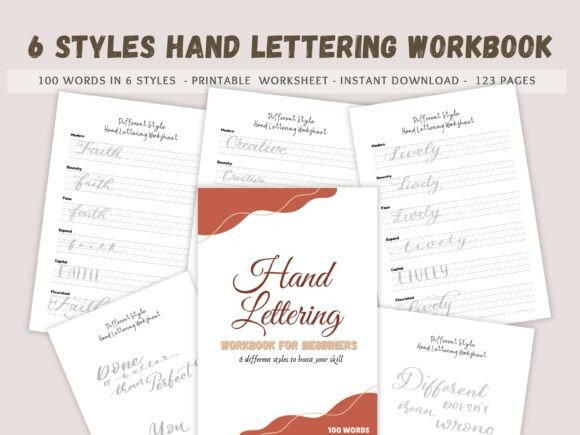
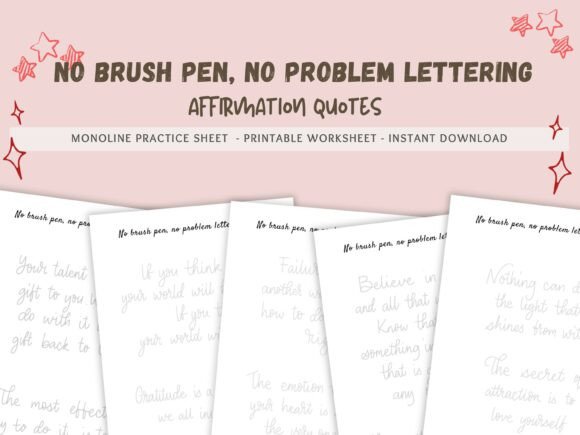
The Handlettering Practice Sheet Monoline Lettering Workbook isn’t just another printable—it’s a thoughtfully structured daily companion. Each page features:
- Inspirational life quotes carefully selected for emotional resonance and mindfulness—phrases like “I am enough,” “Progress over perfection,” and “My calm is my power”;
- Guided tracing zones with light gray letterforms to build muscle memory;
- Free-form practice space for experimentation and personalization;
- Consistent monoline alphabets (uppercase, lowercase, numerals) modeled for balance and readability;
- Spacing guides and baseline rulers to reinforce typographic fundamentals.
This structure supports both deliberate practice and creative play. For beginners, tracing builds confidence before moving to independent lettering. For seasoned practitioners, the affirmations spark fresh layouts, color experiments, or digital adaptations—especially when used with Procreate lettering (the PDFs are print- and screen-ready).
No Brush Pen? No Problem.
A common misconception is that lettering requires expensive tools. In reality, no brush pen, no problem is more than a tagline—it’s a philosophy embedded in this workbook. Because monoline work emphasizes form over flourish, everyday writing instruments perform beautifully:
- A Pilot G-2 07 gel pen delivers smooth, opaque lines perfect for journaling;
- A Sakura Pigma Micron 01 offers archival precision for scanning and digital use;
- Even a standard BIC ballpoint works—ideal for students or travelers who want portable practice.
This accessibility bridges gaps across age, budget, and ability. Teachers use it in inclusive classrooms; therapists integrate it into anxiety-reduction routines; retirees rediscover joy through low-stakes creativity. It’s not about perfection—it’s about presence.
Practical Uses Across Life and Learning
Far from being limited to hobbyists, monoline lettering has real-world utility in multiple domains:
Educational Settings
In schools, teachers print the A4 21 x 29.7 cm version for whole-class warm-ups, while students use the compact A5 14.8 x 21 cm size in composition notebooks. The repetition of affirming phrases reinforces social-emotional learning (SEL) goals—blending literacy, art, and wellbeing seamlessly.
Digital Creativity & Remote Work
With the rise of remote collaboration and visual communication, professionals use monoline lettering to design custom slide headers, Slack banners, Notion dashboards, or Canva templates. The included US Letter Size file ensures compatibility with North American printers, while high-resolution PDFs scale cleanly for Procreate or Adobe Illustrator vector conversion.
Mindful Living & Mental Wellness
Research shows that focused, rhythmic handwriting activates the parasympathetic nervous system—slowing heart rate and reducing cortisol. Pairing that with positive affirmations creates a dual-layer wellness tool. Users report improved focus, reduced overwhelm, and deeper self-connection after just 5–10 minutes of daily practice.
Clarifying Common Misconceptions
Let’s clear up a few assumptions:
- “Monoline = boring.” Not true. Uniform line weight invites creativity in shape, contrast, layout, texture, and composition. Try varying letter height, overlapping words, or adding minimalist icons—you’ll see how expressive monoline can be.
- “Only for artists.” False. This workbook is designed for anyone who writes—students, engineers, nurses, entrepreneurs, parents. You don’t need “artistic talent”; you need curiosity and consistency.
- “Digital lettering requires tablets.” While Procreate enhances flexibility, these worksheets are equally effective printed and handwritten. The PDF format ensures crisp lines whether viewed on iPad or photocopied at school.
Getting Started: Your First 3 Steps
- Choose your size: Download the A4, A5, or US Letter version based on your printer or preference. All contain identical content—just optimized for different workflows.
- Pick your pen: Start with what you already own. A medium-point black pen is ideal for visibility and control. Avoid feathering or bleed-through by testing first on scrap paper.
- Practice one quote per day: Spend 7–12 minutes. Trace once, then rewrite freely. Notice how spacing feels. Celebrate small wins—like aligning ascenders or centering a word.
Over time, you’ll notice improvements not just in letterform accuracy—but in patience, attention, and self-compassion. That’s the quiet magic of affirmation lettering practice: it trains the hand while nurturing the mind.
Why This Workbook Stands Out
Many lettering resources prioritize aesthetics over pedagogy—or overwhelm beginners with jargon and complex drills. This Monoline Lettering Practice Worksheet stands apart because it:
- Centers emotionally intelligent content—not just random alphabets;
- Offers three universal print sizes, eliminating formatting frustration;
- Is intentionally tool-agnostic, honoring diverse access points to creativity;
- Supports both analog reflection and digital iteration, meeting users where they are;
- Aligns with evidence-based practices in neuroplasticity and habit formation.
It’s not just about learning to write beautifully—it’s about reclaiming agency over your attention, voice, and inner narrative. Every traced “I choose joy,” every hand-drawn “This too shall pass,” becomes a gentle act of resistance against distraction and doubt.
Final Thought: Lettering as Lifelong Learning
In a world accelerating with AI-generated text and algorithmic feeds, there’s profound value in slowing down to form each letter by hand. Monoline lettering doesn’t ask you to be perfect—it asks you to be present. Whether you’re sketching affirmations beside your morning coffee, designing a birthday card for a friend, or annotating a business plan with visual flair, this workbook meets you with warmth, structure, and quiet encouragement.
You don’t need permission to begin. You don’t need special training. You just need a pen, a page, and the willingness to try. So go ahead—enjoy, relax, and practice lettering. Your hands—and your heart—will thank you.