Teach Kids Financial Literacy Early with a Fun, Editable Money Workbook for Kids
Financial literacy isn’t just for adults—it’s a foundational life skill that begins long before a child opens their first bank account. In fact, research from the University of Cambridge shows that children form money habits by age 7. That’s why introducing money concepts early—through play, storytelling, and hands-on practice—is not just helpful, it’s essential. Enter the Money Workbook for Kids: a vibrant, Canva-editable template designed to make financial learning joyful, accessible, and deeply engaging for young learners ages 5–12.
Why Financial Literacy Starts in Childhood
Many parents assume kids will “pick up” money skills naturally—through observation or occasional conversations about allowance. But passive exposure rarely builds confidence or competence. Without structured, age-appropriate guidance, children may struggle later with budgeting, delayed gratification, or distinguishing between needs and wants. Worse, misconceptions can take root: “Money grows on trees,” “Only rich people save,” or “Talking about money is boring or scary.”
A well-designed money workbook for kids dismantles these myths—not through lectures, but through doing. When a child colors in their Savings Jar Tracker, sets a goal to buy a new book using their Earn, Save, Spend, Share Tracker, or runs a pretend Play Store Budgeting Game, they’re not just completing worksheets. They’re building neural pathways tied to decision-making, self-regulation, and real-world problem solving.
What Makes This Canva-Editable Template Stand Out?
This isn’t a static PDF printed once and forgotten. It’s a fully customizable, Canva-editable template—meaning educators, parents, and homeschoolers can adapt every page to match their child’s interests, reading level, cultural context, or learning goals. Want to swap out “dollars” for “euros” or “pesos”? Done. Prefer illustrations of diverse families, inclusive chores, or local currency visuals? Easy to update. Need larger fonts for emerging readers or simplified language for neurodiverse learners? Built-in flexibility supports differentiation without extra prep time.
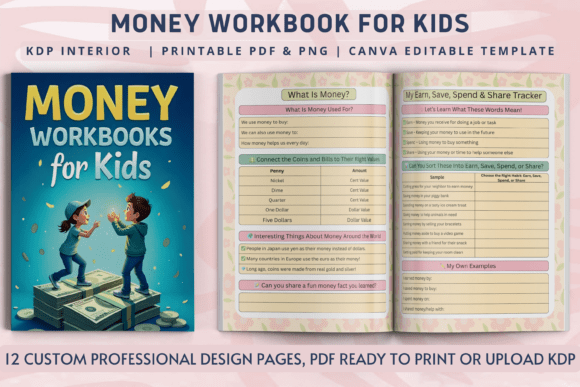
Inside the Workbook: 12 Purposeful, Research-Informed Activities
- Free Book Cover & “This Book Belongs To” Page — Fosters ownership and pride. Personalization increases engagement and signals that this is *their* financial journey—not a generic assignment.
- What Is Money? — A gentle, visual introduction using relatable analogies (e.g., “Money is like a tool—just like a spoon helps you eat, money helps you get things you need or want”). Avoids abstract definitions in favor of concrete understanding.
- My Earn, Save, Spend, Share Tracker — Introduces the four core pillars of money management. Children log coins from chores, birthday gifts, or lemonade stands—and decide how much goes where. Reinforces agency and intentionality.
- My Money Goals — Guides kids to set short-term (a sticker pack), medium-term (a board game), and long-term (a bike) goals—with space to draw, write steps, and celebrate milestones.
- My Chores and Money Tracker — Links effort to earnings in a transparent, consistent way. Includes optional “bonus challenge” prompts to encourage initiative (e.g., “Help fold laundry without being asked!”).
- Sorting Needs and Wants — Uses illustrated cards or cut-and-paste activities to clarify distinctions—not as rigid rules, but as thoughtful filters for everyday choices.
- My Savings Jar Tracker (Color It In!) — A tactile, visual motivator. Each filled section represents progress—not just toward a purchase, but toward patience and planning.
- Play Store Budgeting Game — A printable marketplace with price tags, shopping lists, and “cash” cards. Kids practice addition, subtraction, making trade-offs, and handling “change”—all while laughing over imaginary purchases.
- Smart Shopper Worksheet — Teaches comparison shopping: “Which cereal gives more cereal per dollar?” or “Is the bigger juice box really a better deal?” Builds critical thinking beyond math.
- Money Vocabulary Builder — Introduces terms like *budget*, *interest*, *donate*, and *income* through matching, drawing, and sentence-building—not rote memorization.
- Reflection: What I Learned — Prompts metacognition: “What was hard? What surprised me? What would I teach a friend?” Encourages growth mindset and deeper retention.
- Notes Page — Blank space for doodles, questions, parent-child notes, or teacher feedback. Honors curiosity and ongoing dialogue.
Who Benefits—and How?
Parents gain a low-pressure, screen-free tool to start meaningful money conversations—no finance degree required. Use it during weekend routines, summer learning, or as part of a “family finance night.”
Teachers integrate it across subjects: math (counting, percentages), social studies (economy, community roles), language arts (goal-setting narratives, vocabulary), and SEL (responsibility, empathy through “Share” tracking). Aligns with Common Core and CASEL standards.
Homeschoolers appreciate its modular design—use one page per week or bundle activities into themed units (e.g., “Earning Week,” “Saving Challenge Month”).
Educational creators and therapists leverage the editable format to tailor content for specific populations—students with ADHD (visual trackers reduce overwhelm), English language learners (add bilingual labels), or those exploring values-based finance (e.g., “How does sharing money connect to kindness?”).
Beyond Worksheets: Building Lifelong Habits
A common misconception is that financial literacy = knowing how to balance a checkbook. Today’s world demands more: digital wallet awareness, subscription skepticism, ethical consumption, and resilience amid economic uncertainty. This money workbook for kids plants seeds for all of it—not by predicting future tools, but by cultivating core competencies:
- Numeracy + Context — Numbers mean something when attached to real choices (“If I save $2/week, how many weeks until my $20 goal?”).
- Emotional Intelligence — Tracking “Share” builds empathy; reflecting on “What I Learned” develops self-awareness.
- Critical Thinking — The Smart Shopper and Needs vs. Wants pages train discernment—a skill that transfers to media literacy and online safety.
- Growth Mindset — Mistakes in the Play Store are part of the game—not failures. Every tracker celebrates effort, not just outcomes.
Getting Started Is Simple—and Joyful
No printing press, laminator, or lesson-planning marathon needed. Download the Canva template, click “Edit in Canva,” and begin customizing in minutes. Print single pages or compile into a full-color spiral-bound booklet. Add your child’s name, favorite colors, or even photos of their actual piggy bank. Let them choose which activity to start with—autonomy boosts motivation instantly.
And remember: consistency matters more than perfection. Even 10 focused minutes twice a week builds momentum. Celebrate small wins—“You remembered to add your chore money today!” or “You compared two prices all by yourself!” Those affirmations reinforce identity: I am someone who makes smart money choices.
Financial literacy isn’t about raising mini-accountants. It’s about raising confident, compassionate, capable humans—who understand that money is a tool for security, creativity, connection, and contribution. With the right foundation, every child can grow into that person. Start with a workbook that doesn’t just teach money… it invites curiosity, honors play, and believes in their potential.