Growth Mindset Workbook for Kids
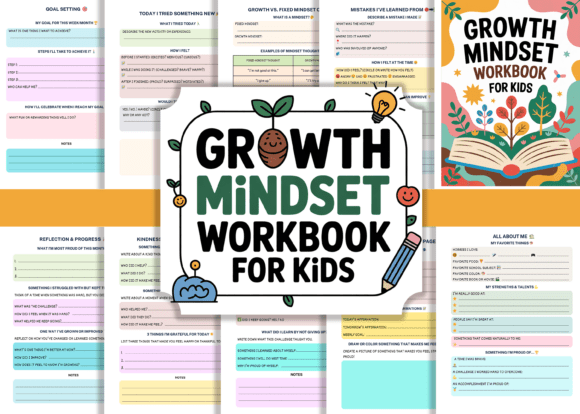
If you're supporting a child’s emotional development—whether as a parent, teacher, counselor, or caregiver—you’ve likely heard how powerful mindset work can be. But not all resources deliver real impact. The Growth Mindset Workbook for Kids stands out because it doesn’t just talk about resilience—it builds it, step by thoughtful step. Designed for children ages 6–12, this 120-page PDF workbook combines evidence-informed psychology with age-appropriate engagement: reflection prompts, visual comparisons, affirmation practice, and hands-on tracking tools. It’s not a passive coloring book or a one-time lesson plan. It’s a scaffolded system that helps kids internalize how effort, strategy, and reflection lead to growth—not just in school, but in friendships, creativity, and self-awareness.
Common Missteps That Undermine Real Progress
Many well-intentioned adults rush into using the Growth Mindset Workbook for Kids without first aligning it with their child’s learning rhythm—or their own capacity to support it. One frequent mistake? Treating the workbook like a checklist. “We’ll do one page a day before bedtime” sounds disciplined—until pages pile up untouched, or kids start resisting because the pace feels forced rather than inviting. Growth mindset isn’t built through compliance; it’s nurtured through curiosity and consistency. When used reactively (e.g., only after a meltdown or failed test), the workbook misses its greatest strength: helping kids notice small shifts *before* big setbacks occur.
Another overlooked detail is skipping the foundational pages—especially All About Me and the Fixed vs. Growth Mindset comparison charts. Without grounding in what makes them unique or how thoughts shape feelings, later sections like Goal Setting Pages or the Challenge Tracker lose meaning. A child might write “I want to get better at math” without understanding *how*—or why believing “I’m not a math person” limits their willingness to try new strategies.
Some buyers assume the Canva-editable pages are plug-and-play for classroom use—but forget to test formatting across devices. Teachers report printing issues when opening editable files on older tablets or school laptops without updated Canva apps. Others download the PDF but don’t realize it’s designed for printing *and* digital annotation (many pages include writable fields). Skipping this step means losing interactivity—and half the value.
What Happens When These Gaps Go Unaddressed?
When adults misapply the workbook, kids often internalize subtle messages: “This is another thing I’m supposed to get right,” or “My mistakes still feel bad—even with this book.” That contradicts the core aim. Without intentional modeling—like sharing your own Learning from Mistakes reflection aloud—the child may see growth mindset as something they *should* have, not something they’re actively practicing alongside a trusted adult.
There’s also a practical cost: time wasted on activities that don’t land, frustration when goals feel vague (“Be braver”), or missed opportunities to reinforce progress. For example, the Kindness Gratitude Journal only builds empathy and emotional vocabulary if entries are discussed—not just collected. Likewise, the Brain Break Mindfulness section works best when practiced *with* the child, not assigned as homework.
Better Ways to Use the Workbook—Starting Today
Begin where the child already shows energy—not where you think they “should” start. If they light up during art, begin with the All About Me collage-style prompts. If they love stories, use the Learning from Mistakes section to co-create a short comic about a time something went wrong—and what helped fix it. Let their voice lead.
Use the Reflection Progress Pages monthly—not as evaluations, but as conversations. Ask: “What’s one thing you tried this month that felt hard at first? What helped you keep going?” Avoid grading effort or comparing to last month. Focus instead on noticing patterns: “I see you wrote ‘asked for help’ three times—that’s a real skill.”
For educators: Integrate the Goal Setting Pages into existing routines—not as an add-on. Tie “Try One New Thing This Week” to science experiments, reading challenges, or peer collaboration tasks. And always preview the Positive Affirmations with the class first. Let kids revise phrases that feel awkward (“I am unstoppable!”) into ones that resonate (“I can figure things out when I take my time”). Authenticity matters more than polish.
What to Check Before You Download or Share
- Device compatibility: Confirm whether you’ll use the PDF digitally (with annotation tools like GoodNotes or Notability) or print it. The workbook includes optimized line spacing and writable fields—but those only function in compatible readers.
- Editable file access: The 14 Canva pages require a free Canva account and basic familiarity with text boxes and image uploads. If you’re new to Canva, spend 10 minutes exploring templates first—no need to master design, just know how to replace placeholder text.
- Child’s current emotional load: If your child is experiencing high stress, grief, or learning challenges, consider starting with just two sections: Brain Break Mindfulness and Kindness Gratitude Journal. Small, soothing practices build safety before tackling bigger mindset shifts.
- Your own readiness to model: Growth mindset grows strongest in relationships—not worksheets. You don’t need to be perfect. You *do* need to be willing to say, “I messed that up. Here’s what I’ll try differently next time.” That moment is worth more than any completed page.
The Growth Mindset Workbook for Kids isn’t about fixing a child. It’s about offering them language, tools, and permission—to try, pause, reflect, and try again. When used with attention to pacing, authenticity, and shared experience, it becomes less of a “resource” and more of a quiet companion in their unfolding confidence. That kind of growth doesn’t shout. It settles—in journal entries, in calmer responses to frustration, in the quiet pride of a child who says, “I didn’t get it yet… but I’m still working on it.”