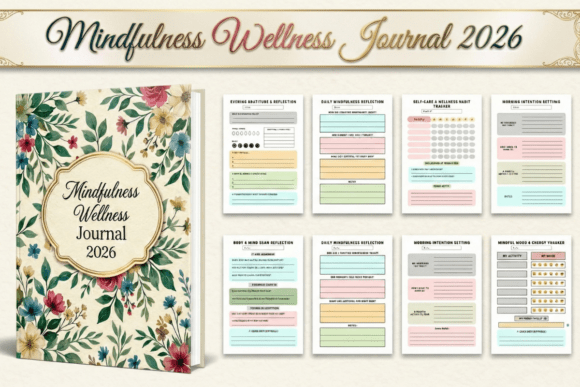
Mindfulness Wellness Journal 2026
Life doesn’t slow down—and neither should your well-being. The Mindfulness Wellness Journal 2026 isn’t another rigid planner or a to-do list masquerading as self-care. It’s a gentle, grounded companion for anyone who senses they’re moving too fast but isn’t sure where to pause—or how to begin again with kindness. Designed as a 120-page printable journal, it meets you where you are: whether you’re sitting in silence for the first time this week, juggling remote work and caregiving, recovering from burnout, or simply craving more presence in ordinary moments like sipping tea or walking the dog.
Real Life, Not Ideal Life: Where This Journal Fits In
Think about your Tuesday at 4:17 p.m.—email inbox blinking, lunch half-eaten, shoulders tight, and that low hum of “I should be doing more.” That’s exactly when the Mindfulness Wellness Journal 2026 becomes quietly essential. It doesn’t ask you to clear your schedule or commit to an hour-long meditation. Instead, it offers micro-moments of reconnection: a two-minute morning intention, a breath check-in before replying to a stressful message, or an evening reflection that helps you notice—not fix—how your day truly felt.
For the mindfulness beginner, it removes guesswork. No need to search “what do I write in a meditation journal?”—the daily mindfulness prompts guide you with warmth and specificity: *“What sensation did you notice most clearly today—the weight of your feet on the floor? The sound of rain? The warmth of sunlight on your arm?”* These aren’t abstract questions—they’re invitations to land in your body, right now.
Remote workers and freelancers often struggle with blurred boundaries and decision fatigue. The Mindfulness Wellness Journal 2026 includes a Year-at-a-Glance spread not for scheduling deadlines—but for spotting patterns: *When do I feel most energized? When does my focus naturally dip? Which meetings drain me—and which ones light me up?* Paired with monthly calendars that highlight U.S. holidays (and space to note personal observances), it supports intentional planning—not just productivity, but sustainability.
Teachers, nurses, therapists, and other care-focused professionals carry emotional weight daily. This journal holds space for that labor without judgment. The Evening Gratitude Reflection doesn’t push forced positivity. Instead, it asks: *“What small thing held steady for you today?”* or *“What boundary did you honor—even imperfectly?”* That subtle shift—from achievement to acknowledgment—makes all the difference when compassion is in short supply.
More Than Prompts: How Structure Supports Softness
The mindful breathing awareness exercises—like box breathing guides and mindful counting breaths—are embedded directly into reflection pages, not tucked away in an appendix. Why? Because breath awareness works best when it’s woven into routine, not treated as a separate “task.” You might use the box breathing tracker after a difficult conversation, then jot down one sentence about what shifted—before or after the exhale.
Similarly, the Morning Intention Setting page avoids vague affirmations (“I will be joyful!”). Instead, it invites: *“How do I want to show up—in my tone, my posture, my pauses?”* That specificity matters. A parent might choose *“I’ll kneel to meet my child’s eyes before speaking”*; a software developer might pick *“I’ll mute notifications for my first 30 minutes of deep work.”* Intentions become tangible—and trackable—without pressure.
The Daily Mindfulness Reflection is intentionally open-ended but never empty. It includes gentle scaffolding: checkboxes for common anchors (breath, sound, movement, taste), a line for one “moment of presence,” and room for a single gratitude—not a list. This design honors real human capacity. Some days, noticing *one* breath is enough. The journal celebrates that.
Who Benefits—and How It Shows Up Differently
- Students (college & grad): Use the 2026 Monthly Calendars alongside academic deadlines—but add color-coded “recharge blocks” (not study blocks). The Emotional Awareness Tracker helps spot stress triggers before finals week spirals—like noticing irritability spikes every time group project messages pile up.
- New parents & caregivers: The Evening Gratitude Reflection includes space for “tiny wins”—a full night’s sleep, a shared laugh, a meal eaten warm. No grand gestures required. It validates exhaustion while gently widening the lens to include resilience.
- Creatives & makers: The journal’s clean, uncluttered layout (no decorative borders competing for attention) gives mental breathing room. Many use it alongside sketchbooks—writing a few lines on the left page, doodling a grounding shape (a spiral, a leaf, a wave) on the right.
- Therapy clients & support group members: Therapists often recommend this as supplemental work between sessions. Its non-clinical language (“What emotion sat with you longest today?” vs. “Identify primary affect”) makes emotional exploration feel safe, not diagnostic.
Practical Considerations Before You Begin
This isn’t a magic reset button—and it’s not meant to be. The Mindfulness Wellness Journal 2026 works best when approached with curiosity, not compliance. If you miss three days? The next page still waits—no shame, no catch-up required. It’s designed for consistency over perfection.
As a self-care printable, it’s instantly accessible—you download, print, and start. No shipping delays, no subscription fees. But because it’s printable, consider your setup: Do you have a reliable printer? Would a spiral-bound version suit your flow better? (Many users print quarterly and bind sections themselves.) Also, while digital journaling apps offer reminders, this journal’s physicality—pen on paper, turning a page—creates a tactile anchor that screens can’t replicate.
It’s also not a replacement for clinical support. If anxiety, depression, or trauma symptoms feel overwhelming, this journal complements professional care—it doesn’t substitute for it. Its strength lies in building daily awareness, not crisis intervention.
Why “2026” Matters More Than You Think
Choosing a mindfulness journal 2026 isn’t just about dates—it’s about psychological freshness. Starting fresh with a new year signals permission to release old habits, even subtly. The holiday list (U.S.-based, with room to add personal or cultural observances) helps you plan mindfully around high-stimulus times—like prepping a calming ritual before Thanksgiving travel, or scheduling rest *after* New Year’s Eve instead of only before.
And because it’s built for the full year—not just January—the Year-at-a-Glance becomes a living document. Flip back in July to see how your “calm priority” evolved from “meditate 5 mins” to “pause before checking email.” That visible growth—quiet, uncelebrated, deeply human—is where real wellness takes root.