Companion Planting Guide: Grow Smarter, Not Harder—With Beauty and Purpose
Gardening shouldn’t mean constant battling—against pests, poor yields, or confusing spacing rules. It should feel intuitive, joyful, and grounded in nature’s wisdom. That’s where a thoughtful Companion Planting Guide makes all the difference—not as a rigid set of rules, but as a living reference that helps you work *with* your garden, not against it.
Whether you’re converting a sun-drenched backyard corner into a food-producing oasis, homeschooling with hands-on botany lessons, or nurturing herbs for wellness and kitchen use, companion planting offers real, observable benefits: fewer aphids on your kale, sweeter tomatoes beside basil, and more bees buzzing around your strawberries. But knowing *which* plants support each other—and which clash—requires reliable, easy-to-apply knowledge. That’s exactly what this Companion Planting Guide delivers: clarity, confidence, and color.
Why Gardeners Reach for This Companion Planting Guide
Many gardeners hit familiar roadblocks—especially early on:
- Pests show up faster than harvests—and chemical sprays contradict eco-conscious values;
- Space feels limited, yet overcrowding leads to disease while underutilizing soil potential;
- Soil health declines year after year, even with compost, because crop rotation and symbiotic pairings aren’t consistently applied;
- Family involvement is low—kids lose interest when gardening feels technical or abstract;
- Information overload—endless blog posts and conflicting advice make it hard to know what truly works in *your* zone, bed, or container.
This Companion Planting Guide meets those needs head-on—not by promising perfection, but by offering practical, visual, and immediately usable support. Designed for real-world application, it turns theory into action without requiring a horticulture degree.
How It Works—And Why the Watercolor Format Matters
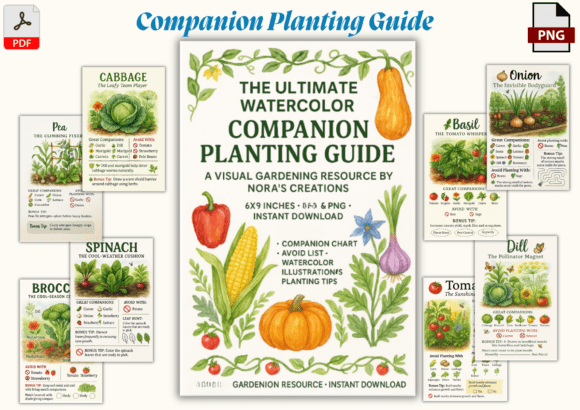
At its core, this Companion Planting Guide pairs science-backed plant relationships with human-centered design. Each of the 20 featured crops—like carrots, cucumbers, marigolds, rosemary, and blueberries—is illustrated in soft, expressive watercolor. These aren’t just decorative: they serve as memory anchors. When you see the gentle brushstrokes of a dill plant beside fennel, you intuitively grasp their kinship—and why they shouldn’t share space. Visual learning sticks, especially for beginners, kids, and visual thinkers.
The 6x9 inch printable format isn’t arbitrary. It fits perfectly inside garden journals, three-ring binders, or laminated pocket charts—so your guide stays where you need it most: at the edge of the raised bed, clipped to a greenhouse wall, or open on the patio table during planning season. And because it’s delivered as both PDF and high-resolution PNG files, you can print it crisp and clear—or import pages directly into digital planners and lesson plans.
Practical Applications You’ll Use All Season Long
Here’s how gardeners across different situations apply this Companion Planting Guide—not once, but repeatedly:
- Backyard growers use the quick-reference charts to plan spring succession planting—e.g., following early peas with carrots (which benefit from the nitrogen left behind) and chives (to deter carrot rust flies);
- Homeschool families turn the interactive pages into nature journal prompts—drawing pollinators spotted near borage, tracking growth rates of interplanted lettuce and radishes, or comparing pest pressure in companion vs. monoculture rows;
- Herbalists and wellness gardeners rely on the herb-specific pairings—like planting lemon balm near tomatoes to repel whiteflies while attracting beneficial wasps, or avoiding sage near cucumbers (a known growth inhibitor);
- Eco-conscious growers lean into the natural pest control tips—using nasturtiums as trap crops for aphids, or yarrow to boost beneficial insect populations—reducing reliance on interventions while increasing biodiversity;
- Small-space urban gardeners maximize vertical and intercropped potential—pairing bush beans with compact peppers and oregano, using the sun exposure notes to orient pots toward optimal light angles.
And because each page includes bonus tips on soil pH preferences, ideal sun exposure, and spacing suggestions, the Companion Planting Guide functions as both a companion reference *and* a foundational growing primer.
More Than a Chart—It’s a Mindset Shift
A great Companion Planting Guide doesn’t just tell you what to plant next to what—it invites deeper observation. You begin noticing how ladybugs gather where dill grows near cabbage. You pause before pulling “weeds” like clover, remembering its role in fixing nitrogen for nearby spinach. You start asking, *What does this patch need—not just this week, but over seasons?*
That shift—from controlling outcomes to cultivating conditions—is where lasting garden success begins. This guide supports that mindset through intentional design: no cluttered text walls, no overwhelming jargon—just clean layouts, consistent icons, and space for handwritten notes. It’s meant to be lived with, marked up, and returned to—season after season.
Tailored for Real People, Not Just Ideal Conditions
No two gardens are alike—and this Companion Planting Guide respects that. While it covers widely adaptable pairings (like basil + tomatoes or nasturtiums + squash), it also flags regional considerations: for example, warning that mint—though a great companion for cabbage—must be grown in containers in most climates due to its aggressive spread. It acknowledges that “avoid” lists aren’t about failure—they’re about honoring plant personalities. Just as people thrive in different environments, so do peppers, parsley, and strawberries.
For homesteaders managing larger plots, the guide’s structure supports long-term planning—using crop groupings to inform multi-year rotations. For apartment dwellers with balcony boxes, it highlights compact, high-yield combos that flourish in containers (think cherry tomatoes, basil, and marigolds in a single 5-gallon pot). The flexibility is built in—not as an afterthought, but as a core principle.
In short, this Companion Planting Guide is more than a download. It’s a quiet invitation—to grow with curiosity, care, and color. To trust patterns over pesticides. To see your garden not as a project to complete, but as a relationship to deepen.
When your tools are beautiful, usable, and rooted in real practice, gardening stops being something you *do*—and becomes part of who you are.