Grandfather, I Want to Hear Your Story
This isn’t just another journal—it’s a quiet invitation. A respectful pause in a fast-moving world, offering Grandpa space, structure, and gentle encouragement to reflect, recall, and record what matters most. Grandfather, I Want to Hear Your Story is a guided memory book designed with emotional intelligence and design intentionality. Its layout breathes—plenty of white space, clear typography, intuitive progression, and thoughtful visual cues that guide without dictating. The aesthetic is warm but not cutesy, timeless but not dated: soft serif headings paired with clean, readable sans serif body text; subtle borders and section dividers that feel hand-drawn, not clip-art. It avoids nostalgia as decoration—it leans into authenticity instead.
The printable format is intentional. It’s not a mass-produced hardcover with rigid binding—it’s flexible, personal, and tactile. You print it on your choice of paper stock (a slightly textured cream for warmth, or bright white for clarity), bind it however feels right (stapled for immediacy, spiral-bound for ease of use, or perfect-bound for heirloom weight), and gift it with presence—not packaging. That physicality matters. When Grandpa holds it, opens it, sees his name on the “This Book Belongs To” page, he’s not filling out a form—he’s stepping into a role: storyteller, keeper, bridge.
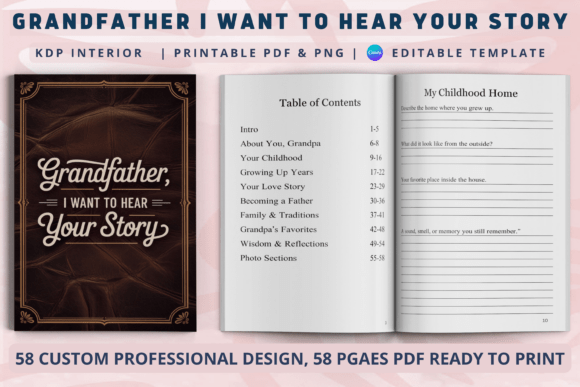
What makes this more than a collection of prompts is how those prompts are sequenced. It begins with identity (“About You, Grandpa”), moves through formative years (“Your Childhood,” “Growing Up Years”), then pivots to relational milestones (“Your Love Story,” “Becoming a Father,” “Family Traditions”). It doesn’t rush to wisdom—it lets wisdom emerge organically from lived experience. The “Wisdom Reflections” section arrives late, after memory has been honored, not before. And the photo section isn’t an afterthought—it’s integrated thoughtfully, with captions that invite context, not just identification (“Who’s in this picture? What were you all doing? What did it feel like?”).
This design approach directly supports readability and emotional accessibility. Short lines, generous leading, and consistent hierarchy reduce cognitive load—critical for older writers who may be new to journaling or managing vision changes. The black-and-white interior isn’t a cost-cutting compromise; it’s a deliberate choice for printer-friendliness, contrast clarity, and timeless reproduction across generations. No ink bleed, no color dependency—just legibility, reliability, and reverence for the words.
Where This Journal Lives—and Why It Works
Grandfather, I Want to Hear Your Story thrives where intention meets utility: in quiet Sunday afternoons, hospital waiting rooms, retirement community activity centers, or beside a favorite armchair. It’s equally at home as a digital download shared across time zones (a granddaughter emails it to her grandfather overseas) or as a printed keepsake tucked into a birthday card. Its 6x9-inch size fits naturally in hands, on shelves, and in memory boxes—neither too bulky nor too slight.
For creators and small businesses, it’s a versatile design asset. Bloggers writing about intergenerational connection use it as a tangible resource in their posts. Family historians embed its structure into workshops. Gift shop owners pair it with archival pens or linen journals. Publishers repurpose its prompt framework for companion workbooks. Its PDF format means zero inventory risk, instant delivery, and easy localization—swap a few phrases, adjust date formats, and it serves families globally.
Design Integrity Meets Human Purpose
The journal’s typography reflects its dual mission: warmth and clarity. The cover uses a gentle serif—approachable but grounded—while interior pages rely on a highly legible, humanist sans serif. There are no decorative script fonts masquerading as “personality.” No forced whimsy. Every typographic decision serves comprehension first, then tone. That’s modern typography at its most responsible: invisible when it works, unmistakable when it doesn’t.
This attention to type extends to practical use. The PDF includes bleed for professional printing, standard margins for home printers, and logical page numbering that respects double-sided printing. It’s built for real-world constraints—not theoretical perfection. If you’re evaluating it for commercial resale or gifting, test-print a few key spreads: the “Welcome, Grandfather” page (does the tone land?), the photo caption templates (are they spacious enough for handwriting?), and the “How to Use This Book” spread (is the guidance truly frictionless?). Those three pages tell you everything you need to know about whether the design honors its user.
More Than a Journal—A Legacy Scaffold
Legacy isn’t built in grand declarations. It’s woven line by line—in how Grandpa describes his first bicycle, the smell of his mother’s kitchen, the nervousness before proposing, the pride in holding his first grandchild. Grandfather, I Want to Hear Your Story provides the scaffold for that weaving. It doesn’t ask for perfection. It asks for presence. It assumes value in ordinary moments—the kind often lost to time unless gently retrieved.
That’s why families return to it year after year. Not because it’s flashy—but because it’s faithful. Faithful to memory. Faithful to voice. Faithful to the quiet dignity of a life well-lived, even if imperfectly remembered. When printed, filled, and passed down, it becomes something rare in our digital age: a physical artifact that carries weight, texture, and time in equal measure.
If you’re choosing this for a grandfather, you’re not just giving paper and prompts—you’re giving permission. Permission to be remembered. To matter. To speak, and to be heard—not just now, but decades from now, when a great-grandchild traces those handwritten words and feels the pulse of a story that began long before they were born.