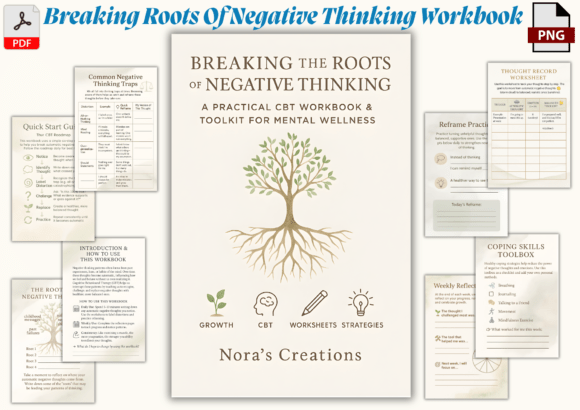
Roots of Negative Thinking Workbook
If you’ve ever paused mid-sentence in a team meeting, second-guessing whether your idea was “good enough,” or scrolled through social media only to feel drained and self-critical afterward—you’re not alone. Automatic negative thoughts (ANTs) don’t just cloud mood; they shape decisions, stall creative work, erode confidence in client calls, and quietly undermine daily productivity. The Roots of Negative Thinking Workbook isn’t another abstract self-help checklist. It’s a compact, 6x9-inch printable CBT tool grounded in clinical practice—designed for people who need clarity *now*, not someday.
Why a Small Workbook Can Make a Real Difference
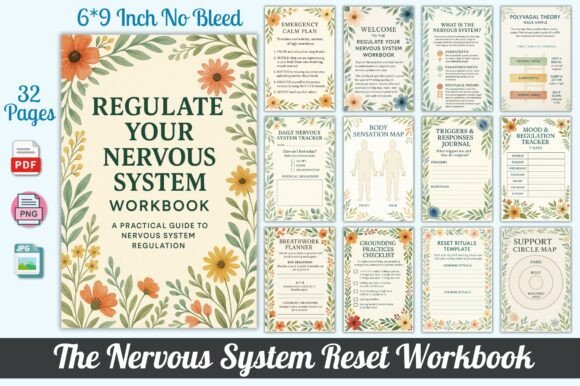
At just 15 pages, the Roots of Negative Thinking Workbook avoids overwhelm while delivering structure where it matters most: pattern recognition, cognitive reframing, and consistent reflection. Unlike dense textbooks or open-ended journaling, this workbook guides users step-by-step through identifying thought distortions—like catastrophizing before a presentation or personalizing feedback from a colleague—and replacing them with grounded, evidence-based alternatives. Each page serves a distinct function: one helps isolate the trigger and physical response to a negative thought; another walks you through evaluating its accuracy using real-life evidence; a third supports drafting a compassionate, realistic reframe.
This precision saves time. A freelance writer struggling with imposter syndrome before pitching can complete a full ANT analysis in under 10 minutes—and return to her draft with clearer focus. A small business owner preparing for investor talks might use the weekly reflection tracker to spot recurring anxiety patterns tied to financial language, then adjust messaging *before* the meeting—not after damage is done.
More Than Just “Positive Thinking”
The Roots of Negative Thinking Workbook doesn’t ask you to force optimism. Instead, it teaches discernment: distinguishing between useful caution (“I should rehearse this pitch”) and unhelpful distortion (“They’ll think I’m incompetent”). That distinction is critical for professionals whose credibility hinges on authenticity—not pep talks. Therapists use it to reinforce session insights between appointments; educators adapt pages for student SEL activities; coaches integrate the coping plan template into onboarding workflows. Even psychology students find it valuable as a low-stakes way to practice CBT concepts before applying them clinically.
The inclusion of mindfulness-based exercises—brief, sensory-grounded prompts—adds stability without demanding meditation experience. For a marketer juggling tight deadlines, pausing for a two-minute breath-and-observation prompt (built right into the workbook) isn’t indulgent—it’s a reset that prevents decision fatigue during campaign reviews.
Who Benefits Most—and When It Fits Best
The Roots of Negative Thinking Workbook shines for those already engaged in growth—whether in therapy, coaching, or self-directed learning—but who need portable, repeatable scaffolding. It works especially well alongside talk therapy (as homework or reinforcement), peer support groups, or accountability partnerships. Freelancers, content creators, and educators report using printed copies pinned near their desks—not as a cure-all, but as a reliable “mental tuning fork” when energy dips or self-doubt spikes.
It’s less suited for someone seeking crisis intervention, deep trauma processing, or long-form psychoeducation. Those needs are best met with licensed support—and the workbook itself encourages that boundary. Nora’s Creations designed it to complement care, not replace it. If you're new to CBT concepts, the guided prompts lower the entry barrier; if you’re experienced, the clean layout and intentional whitespace make revisiting core skills feel refreshing, not repetitive.
Practical Integration—Not Just Another PDF on Your Drive
Because it’s delivered as both PDF and PNG files, the Roots of Negative Thinking Workbook adapts to how you work. Print it for tactile engagement (many users highlight, annotate, or tear out pages for daily use). Load the PNG into note-taking apps like GoodNotes or Notion for digital journaling with handwriting or voice notes. Its 6x9-inch size fits neatly in a planner sleeve or therapy notebook—no resizing, no formatting hiccups. That practicality matters: when emotional bandwidth is low, frictionless access increases follow-through.
One counselor shared how she prints single pages for clients to complete before sessions—then uses their responses to guide conversation more efficiently. A blogger preparing a series on mental wellness used the Certificate of Growth page not as an endpoint, but as a visual anchor in her editorial calendar—tracking progress across three months of writing about anxiety management. These aren’t hypotheticals. They reflect how the workbook meets real workflow rhythms.
What Makes This Different From Other CBT Resources
Many CBT tools prioritize comprehensiveness over usability—lengthy explanations, dense theory, or rigid structures that don’t bend to individual pace. The Roots of Negative Thinking Workbook flips that. Its 15 pages are tightly curated: no filler, no redundant prompts, no vague affirmations. Every exercise links directly to a research-backed technique—cognitive restructuring, behavioral activation cues, affect labeling—and explains *why* it works in plain language. The weekly reflection tracker doesn’t just ask “How did I feel?” It asks, “What thought preceded that feeling? What did I do differently? What evidence supports or challenges that thought?” That specificity builds metacognitive skill—not just awareness, but agency.
For wellness creators building digital products, the clean, minimalist design also offers subtle inspiration: proof that therapeutic rigor and aesthetic calm aren’t mutually exclusive. You don’t have to choose between clinical integrity and approachability.
Ultimately, the Roots of Negative Thinking Workbook meets a quiet but widespread need: the desire to interrupt habitual thinking—not with willpower, but with practiced skill. It won’t eliminate stress, uncertainty, or difficult emotions. But it gives you a reliable way to respond—not react—when your inner critic speaks up. And in a world where attention is fragmented and pressure is constant, that kind of grounded responsiveness is both rare and deeply practical.