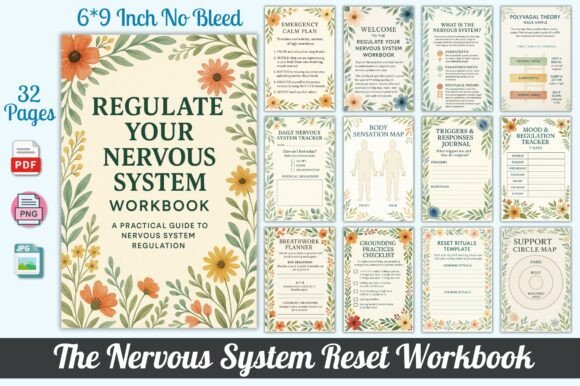
The Nervous System Reset Workbook
Have you ever felt stuck in a loop of exhaustion, irritability, or numbness — even when nothing “big” is happening? You’re not imagining it. Chronic stress, past overwhelm, or ongoing uncertainty can leave your nervous system running on fumes: either revved up and reactive, or shut down and disconnected. That’s where The Nervous System Reset Workbook steps in — not as a quick fix, but as a compassionate, printable companion for reclaiming safety, rhythm, and presence in your own body.
What Is This Workbook — Really?
The Nervous System Reset Workbook is a somatic healing journal designed to meet you where you are — whether you're navigating recovery from trauma, living with high sensitivity, managing burnout as a caregiver or entrepreneur, or simply trying to feel more grounded in daily life. It’s not a clinical manual or a rigid program. Instead, it’s a gentle, structured invitation to notice, name, and gently reshape how your body holds experience.
Rooted in polyvagal theory, somatic psychology, and trauma-informed practice, the workbook translates complex nervous system science into accessible language and actionable steps. Think of it as a personal regulation toolkit — one that fits in your notebook, your therapy session, or your morning coffee nook.
🧠 Nervous System Education — Without the Overwhelm
Understanding your nervous system isn’t about memorizing acronyms — it’s about recognizing your own patterns. The workbook introduces the sympathetic (fight-or-flight), parasympathetic (rest-and-digest), and dorsal vagal (shutdown) states through clean visuals and relatable examples. You’ll learn to spot early signs — like jaw tension before a meltdown, or sudden fatigue after a Zoom call — and begin naming them with kindness instead of judgment.
🌬️ Somatic Exercises — Movement That Meets Your Capacity
This isn’t about intense workouts or breath-holding challenges. The somatic tools in The Nervous System Reset Workbook prioritize safety and choice: gentle neck rolls to soothe vagal tone, weighted hand rests for grounding, humming or sighing to activate calming pathways, and micro-movements you can do seated at your desk. Each exercise includes clear “why this works” notes — so you understand the physiology behind the practice, not just the instruction.
🪷 Reflective Journal Prompts — Not Just “How Do You Feel?”
Traditional journaling sometimes asks too much too soon. These prompts are intentionally paced and embodied: “Where did you first feel that emotion — throat? shoulders? belly?” or “What’s one small thing your body asked for today, and did you listen?” They guide nervous system mapping — helping you identify personal triggers, safety anchors, and subtle shifts in energy over time. No pressure to write pages. A sentence, a sketch, or even a color swatch counts.
📈 Progress Tracking — Not Perfection, But Pattern Recognition
Rather than tracking mood scores or productivity, the workbook invites you to observe sensations, rhythms, and relational capacity. A simple weekly grid helps you note things like: “Felt my feet on the floor three times today,” “Spoke up in a meeting without shaking,” or “Slept through the night — first time in weeks.” This builds evidence of change — especially vital when healing feels invisible or slow.
Who Benefits — And Where It Fits In Real Life
The Nervous System Reset Workbook serves people across many roles and rhythms:
- Trauma survivors who want to rebuild safety without retraumatizing themselves;
- Highly sensitive people (HSPs) who regularly absorb environmental stress and need sustainable ways to discharge and reset;
- Therapists and coaches seeking a non-clinical, client-friendly tool to reinforce somatic work between sessions;
- Creatives and entrepreneurs navigating unpredictable workflows, deadline pressure, and the emotional labor of self-employment;
- Parents and caregivers whose nervous systems are constantly attuned to others’ needs — often at the expense of their own regulation.
It’s equally useful in quiet moments (a 10-minute morning ritual), transitional spaces (before a difficult conversation), or as part of a longer-term healing arc. One user shared how she used the grounding prompts during her commute — turning a stressful bus ride into a chance to reconnect with her breath and posture. Another printed pages to keep beside her bed, using the vagus nerve exercises whenever nighttime anxiety surfaced.
Practical Considerations: Strengths & Realistic Expectations
Strengths:
- Printable flexibility — At 6 × 9 inches, it’s compact enough for travel yet spacious enough for writing or doodling. Print only what you need, when you need it.
- No tech dependency — No app subscriptions, login screens, or battery anxiety. Just pen, paper, and presence.
- Therapist-aligned, self-paced — Designed to complement, not replace, professional support. Many clinicians recommend it as a take-home resource.
What It’s Not:
- It’s not a substitute for mental health care in cases of active crisis, severe dissociation, or unmanaged PTSD symptoms.
- It doesn’t promise overnight transformation. Regulation is a practice — not a destination — and progress often looks like tiny recalibrations, not dramatic breakthroughs.
- It’s not prescriptive. There’s no “right way” to fill it. Skipping pages, revisiting old entries, or using it solely for breathwork is all valid.
Getting Started — Simple, Not Perfect
You don’t need to begin on page one. Try this:
- Flip to the “Grounding Anchor” prompt — identify one sensory cue (e.g., the weight of your sweater, the sound of rain) that reliably brings you into the present.
- Try the “5-Second Sigh” exercise — inhale quietly for five seconds, exhale fully for five. Repeat three times. Notice what shifts — even slightly.
- Circle one weekly tracking box — just one. Maybe “I paused before reacting.” That’s data. That’s growth.
Over time, these micro-practices build neural pathways that support steadier regulation — less reliance on external fixes, more trust in your body’s innate wisdom.
Why This Approach Matters Now
In a world of constant input — notifications, expectations, comparison — our nervous systems weren’t built for perpetual activation. Yet most self-help tools still focus on thought restructuring or habit stacking, skipping the foundational layer: the body’s state. The Nervous System Reset Workbook starts there. It honors that healing begins not with changing your mind, but with befriending your physiology.
Whether you’re rebuilding after loss, learning to parent from a regulated place, launching a business without burning out, or simply wanting to feel more like yourself again — this workbook meets the moment with clarity, care, and quiet power. It won’t erase life’s challenges. But it can help you meet them — and yourself — with more resilience, gentleness, and grounded presence.