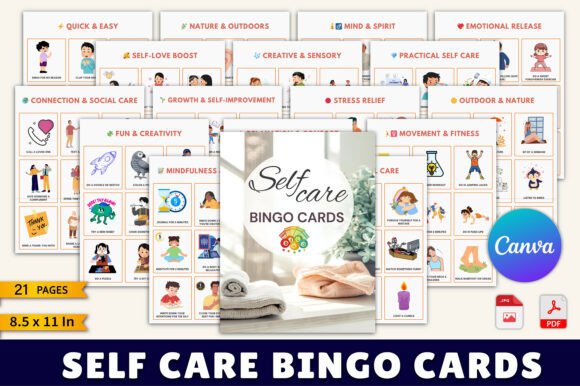
Self Care Bingo Cards: Make Wellness Stick
Sticking to self-care isn’t about willpower—it’s about design. Too often, well-intentioned routines collapse under vague goals (“be healthier,” “reduce stress”) or unrealistic expectations (“I’ll meditate for 30 minutes daily”). That’s where Self Care Bingo Cards shift the dynamic: they turn abstract wellness intentions into tangible, bite-sized actions—each one chosen for its real-world impact, not just its popularity.
This isn’t another checklist disguised as care. The Self Care Bingo Cards Planner is built on behavioral science principles—small wins, variety, and choice autonomy—all wrapped in a playful, low-pressure format. You’re not “failing” if you skip a yoga session; you’re simply choosing a different square that still serves your nervous system, energy level, or emotional needs that day.
Why “Bingo” Works When Other Planners Don’t
Most wellness tools ask you to track what you *should* do. Self Care Bingo Cards asks: *What feels nourishing right now?* That subtle pivot changes everything. A freelance designer burning out mid-week might choose “coloring for 15 minutes” over “read a chapter”—and still build resilience. A teacher juggling lesson plans and family time might pick “call a friend while walking” instead of “hour-long meditation”—and still strengthen connection *and* movement.
The 10 thematic categories—mindfulness reflection, emotional care, creativity fun, nature outdoors, relaxation comfort, movement fitness, social connection, self-improvement, stress relief, and home environment—aren’t arbitrary. They map to evidence-backed pillars of holistic well-being. For example, pairing “gratitude journaling” (mindfulness) with “compliment someone” (social care) reinforces neural pathways linked to positive affect and belonging—both critical for long-term mental health maintenance.
Real Use Cases, Not Idealized Scenarios
For remote workers and entrepreneurs: Back-to-back Zoom calls erode boundaries. Using the planner, you might schedule “tea time + no screens” (relaxation) after lunch and “stretch at your desk for 3 minutes” (movement) before your next meeting. These aren’t grand gestures—they’re micro-interruptions that reset attention and reduce physical strain without adding time to your calendar.
For educators and caregivers: When your energy is constantly poured outward, self-care can feel selfish. The emotional care and stress relief squares—like “say one kind thing to yourself aloud” or “try 4-7-8 breathing for 2 minutes”—require zero prep, zero cost, and under two minutes. They’re designed to fit *between* responsibilities, not compete with them.
For creatives and hobbyists: Inspiration dries up when rest is treated as optional. The creativity fun and nature outdoors sections—“sketch something outside,” “listen to birds for 5 minutes,” “dance to one song”—reconnect you with sensory input and play. That’s not frivolous; it’s cognitive replenishment. Studies show brief, unstructured creative acts improve divergent thinking—the very skill behind breakthrough ideas.
Practical Design Choices That Matter
The editable Canva link and 21 distinct templates aren’t just aesthetic extras—they solve real friction points. Need a version with larger text for low-vision accessibility? Done. Prefer minimalist lines over floral borders to reduce visual load during high-stress weeks? Choose it. Want to swap “volunteering” for “text a mentor” because your bandwidth is thin right now? Editable = adaptable.
The 8.5×11 inch size is intentional: large enough to see clearly without scrolling on a tablet, small enough to print and keep beside your desk, in your journal, or taped to your fridge. And the PDF files are optimized—not bloated with unnecessary layers—so they print crisply whether you’re using a home inkjet or a local print shop.
Who Benefits Most—and Who Might Pause First
This planner shines for people who value structure *but resist rigidity*: professionals managing competing priorities, creators seeking sustainable output rhythms, and anyone rebuilding self-trust after burnout or chronic stress. It’s especially helpful if you’ve tried habit trackers that made you feel guilty—or journals that gathered dust because they demanded too much writing.
That said, it’s not a substitute for clinical support. If you’re navigating severe anxiety, depression, trauma, or chronic illness, Self Care Bingo Cards works best *alongside* therapy, medical care, or trusted guidance—not instead of it. The activities are supportive, not diagnostic or therapeutic. Likewise, if you thrive on highly detailed scheduling (e.g., time-blocking every 15 minutes), this may feel too open-ended—though many users layer it *on top* of their existing systems as a “wellness filter” for daily choices.
Small Shifts, Sustainable Results
Consistency in self-care rarely comes from discipline alone. It comes from alignment—choosing actions that resonate with your current capacity, values, and environment. The bingo format honors that truth. Marking off “cozy clothes + reading fiction” feels different than checking “self-care” off a generic to-do list. It carries intention. It names the *quality* of care—not just the act.
Over time, patterns emerge. You might notice you reach for nature-based squares on heavy workdays, or lean into emotional care when conflict arises. That awareness—gained gently, without judgment—is where real growth lives. It’s how “I should take better care of myself” becomes “I know what helps me settle, and I trust myself to choose it.”
The Self Care Bingo Cards Planner doesn’t promise transformation overnight. It offers something quieter, and more durable: a practical, joyful, repeatable way to return—to your breath, your body, your curiosity—again and again. Not because you have to, but because you remember, in that moment, that you’re worth the small, deliberate attention.